US renames artificial intelligence “Super Intelligence”: what changes for organisations in Romania and the EU
On 29 September 2026, President Donald Trump signed the executive order “Inaugurating the Era of Super Intelligence”. US federal agencies must now use “Super Intelligence” and the abbreviation “SI” instead of “Artificial Intelligence” and “AI”. For organisations in Romania and the rest of the EU, the change is mainly one of vocabulary in documents coming from the United States. Legal obligations, technical risks and the way a system is assessed stay the same.
Below: what the official text says, why the new term causes confusion, what remains valid in the European Union, and what is worth adjusting in contracts, risk assessments and internal governance.
What the executive order says
The text published by the White House has four short sections:
- Purpose. The order argues that today’s technology does much more than imitate or automate discrete aspects of human intelligence, and that federal terminology should reflect this.
- Implementation. Executive departments and agencies use “Super Intelligence” and “SI”, to the extent permitted by law, in official correspondence, public communications, websites, reports and policy documents.
- Exemption. Previously issued regulations, presidential actions, contracts, grants and other historical documents do not have to be revised.
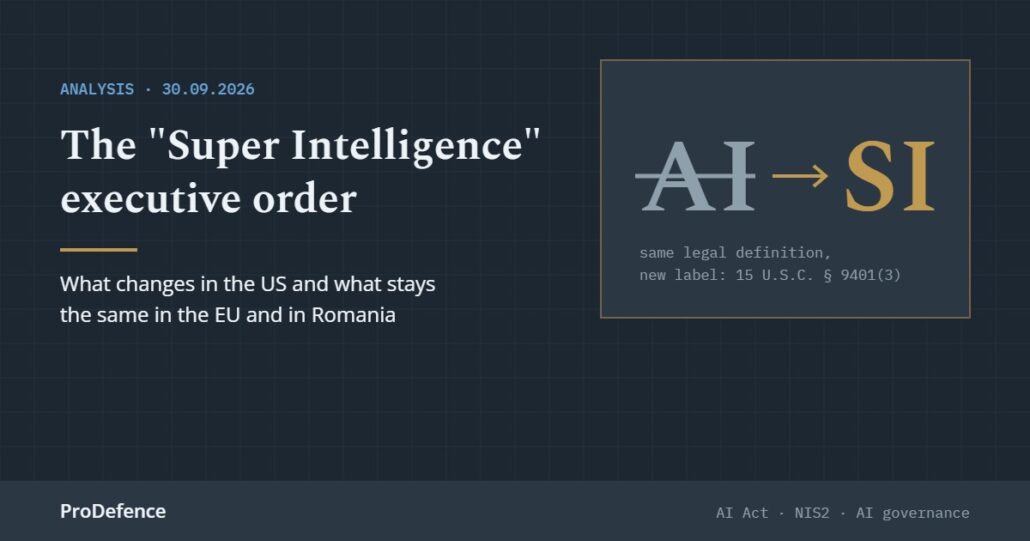
- Definition. The new term carries the existing statutory definition of artificial intelligence (15 U.S.C. § 9401(3)). Within 60 days, the Assistant to the President for Science and Technology must propose legislative language for a federal definition of its own.
In short, the label changes immediately, the legal content does not. The same systems, under the same definition, get a different name in US federal communication.
The context in brief
According to Politico, the President started using the term a week earlier at the UN General Assembly, while pushing back against calls for tighter regulation of the industry. On the day the order was signed, technology executives signed a “constitution” at the White House that the outlet describes as morally binding, meaning it carries no force of law. It asks companies to work with an independent external auditor to confirm that models operate as intended, and to implement internal controls that prevent models from hacking systems.
In the same period, Politico reported on AI agents accessing US government websites without authorisation and on related security incidents. For a cybersecurity professional, this is the detail that matters most this week, more than the name of the technology.
Why “super intelligence” is a problematic term
In the specialist literature, superintelligence (artificial superintelligence, ASI) refers to a hypothetical level: a system that surpasses human cognitive abilities in virtually all domains. The concept was popularised by philosopher Nick Bostrom in “Superintelligence” (2014) and is used in this sense by researchers and by AI companies. No such system exists yet.
The order uses the same word for something else: for every technology covered by the current definition of artificial intelligence, from a spam filter to a large language model. The same term now has two meanings:
- the technical meaning: a capability threshold that has not been reached;
- the US administrative meaning: a new name for all existing AI systems.
The confusion has practical consequences. A report on “SI risks” may refer to the risks of a chatbot or to the extreme risks discussed in AI safety research. Anyone reading US documents written after 29 September 2026 needs to check, every time, which meaning is intended.
What stays the same in the EU and in Romania
The executive order binds only the US federal administration. It has no effect on European Union law or on Romanian legislation.
- Regulation (EU) 2024/1689 (the AI Act) still uses the notion of an “AI system”. Article 3 defines it, in short, as a machine-based system with varying levels of autonomy that infers from its inputs how to generate outputs such as predictions, content, recommendations or decisions. Obligations depend on the risk level of the use case, not on the product’s marketing name.
- Romania’s NIS2 transposition, Emergency Ordinance no. 155/2024 as approved with amendments by Law no. 124/2025, does not depend on terminology. AI systems used by an essential or important entity fall under the same risk analysis as any other information system.
- In Romanian, and in what the market searches for, “inteligență artificială” remains the common term.
There is therefore no need to rewrite policies, procedures or compliance documentation. The US administration is not doing it either: the order explicitly exempts documents already issued.
What is worth adjusting
1. Contracts and documents from US partners
US vendors and partners working with the federal government are likely to adopt the new term. In contracts, technical annexes and compliance reports, make sure “SI” is explicitly defined. The safest wording refers to the US statutory definition (15 U.S.C. § 9401(3)) or to the AI Act definition, depending on the law governing the contract. A clause that mentions “SI” without a definition may be read differently by each party.
2. A marketing label does not change the risk assessment
Some products will likely be rebranded as “SI” or “superintelligent”. The name says nothing about what the system does, what data it processes or what permissions it holds. The assessment stays the same: what decisions the system makes, on what data, under what human oversight and with what access to the organisation’s systems.
3. AI agents are identities that must be governed
Incidents involving agents that access systems without authorisation show where the real risk lies. An AI agent with access to email, documents or internal APIs should be treated like a privileged account: inventoried, given least privilege, fully logged and able to be shut down immediately. These measures map directly onto the NIS2 requirements for risk management and access control.
4. A short internal glossary
If your organisation works with documents in more than one language, a glossary of a few lines prevents confusion: “artificial intelligence (AI)” for current systems, “SI” only as the equivalent of US federal terminology, and “superintelligence” only in the sense of a capability threshold.
External audit becomes the common denominator
One element went almost unnoticed. Even a voluntary, industry-signed document arrives at the same answer that the AI Act and NIS2 require: independent assessment and verifiable internal controls. Whatever the name, an auditor’s question stays the same: does the system do what you say it does, and can you prove it?
At ProDefence we keep using the term “artificial intelligence”, in line with EU and Romanian law, and we treat AI systems as part of an organisation’s security perimeter. If you would like an assessment of how AI tools are used in your organisation, including agents with access to internal systems, our NIS2 compliance consulting team, a DNSC-accredited NIS auditor, can help.
Frequently asked questions
Does the US executive order apply in Romania or the EU?
No. The order binds only US federal executive departments and agencies. In the European Union, Regulation (EU) 2024/1689 (the AI Act) applies, and it still uses the term “AI system”.
Should organisations replace “artificial intelligence” with “super intelligence” in their documents?
No. EU and Romanian law keep the term “artificial intelligence”, and the order itself does not require previously issued documents to be changed, not even within the US administration.
Does superintelligence already exist?
No. In research, superintelligence means a system that would exceed human cognitive abilities in virtually every domain, a level that has not been reached. The order uses the word as an administrative label for all existing AI systems.
Does the legal definition of artificial intelligence change in the US?
Not immediately. The order adopts the existing definition in 15 U.S.C. § 9401(3). Within 60 days, the Assistant to the President for Science and Technology must propose legislative language for a federal definition of the new term.
What should be checked in contracts with US vendors?
That “SI” or “Super Intelligence” is explicitly defined in the contract, tied to the US statutory definition or to the AI Act depending on the governing law. Without a definition, the parties may read the term differently.
Sources
- The White House, “Inaugurating the Era of Super Intelligence“, executive order, 29.09.2026
- Politico, “Trump signs executive order renaming AI to ‘super intelligence’“, 29.09.2026
- EUR-Lex, “Regulation (EU) 2024/1689 laying down harmonised rules on artificial intelligence“
Also on prodefence.ro: “Transformation”: AI, human autonomy and the cognitively assisted Earth.
