Shadow AI at work: a 10-point AI use policy for your company
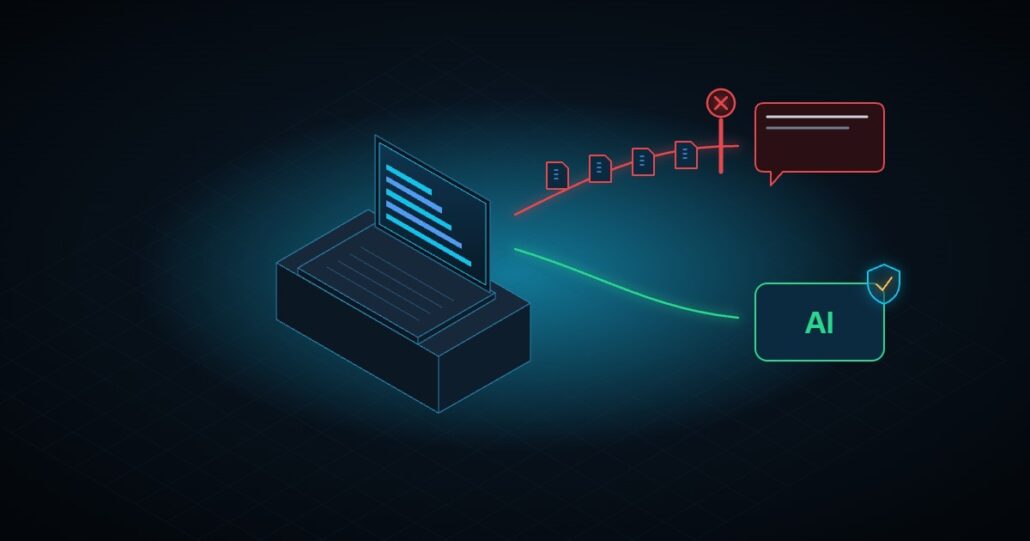
Shadow AI is the use of artificial intelligence tools by staff without the organisation’s approval or control: public chatbots, browser extensions, writing or transcription assistants. The main risk is losing control over data. The answer is not a ban, but a clear policy, an inventory and approved tools.
Key points
- IBM’s Cost of a Data Breach Report 2025 found that about one in five organisations linked a breach to shadow AI, and high levels of shadow AI added roughly USD 670,000 to breach costs.
- Only 37% of the organisations IBM studied had policies to manage AI or detect shadow AI.
- Since 2 February 2025, Article 4 of the AI Act requires organisations using AI systems to ensure sufficient AI literacy among staff.
- Data entered into an unapproved AI tool can leave the company’s control: trade secrets, personal data, client information.
- An AI use policy only works alongside approved tools and training; otherwise staff route around it.
Why shadow AI happens
Employees do not use AI tools to cause harm but to work faster: summarise a contract, translate an email, write code, transcribe a meeting. If the company offers no approved option, they will use a public one, in a personal browser or on their phone.
The problem starts when these tools receive:
- contracts and commercial offers, with prices and clauses;
- personal data about clients or employees;
- source code, access keys, system configurations;
- internal documents on incidents, audits or litigation;
- recordings of board meetings.
Once sent, this data is processed by a provider the company may have no contract with, under conditions nobody has checked.
The concrete risks
| Risk | Example | Consequence |
|---|---|---|
| Confidential information leaks | An employee pastes an offer into a public chatbot to reword it | Loss of control over trade secrets |
| GDPR breach | A client list is uploaded for “cleaning” | Processing without a legal basis or processor contract |
| Access compromise | Code with passwords or API keys sent for review | Unauthorised access to systems |
| Decisions based on wrong output | An inaccurate contract summary is taken as correct | Legal or financial errors |
| Over-permissioned browser extensions | An AI assistant reads every open page | Exposure of internal applications |
| No audit trail | Nobody knows who sent what, where | Incidents cannot be investigated |
IBM also reports that 13% of organisations studied had breaches of AI models or applications, and 97% of those lacked proper AI access controls. The risk is not AI itself, but AI without governance.
What the rules say: AI Act, GDPR and NIS2
AI Act. Regulation (EU) 2024/1689 has required AI literacy for staff using AI systems since 2 February 2025 (Article 4). From 2 August 2026 the transparency duties in Article 50 apply, including for generated content. An internal policy and a training programme are the simplest evidence that a company takes these duties seriously.
GDPR. Any processing of personal data through an AI tool needs a legal basis, information for data subjects and, where the provider processes data on the company’s behalf, a processor contract. Tools used “on the quiet” meet none of these conditions.
NIS2. For essential and important entities in Romania, GEO 155/2024 requires logging and traceability of activity on networks and systems (Art. 11(4)), and lists among the minimum measures access control policies and asset management, supply chain security, cyber hygiene and training (Art. 13). A cloud AI tool used with work data is, in practice, a supplier and an asset to be inventoried.
A 10-point AI use policy
- Purpose and scope. Who it covers (employees, contractors, suppliers with access) and which tools: chatbots, coding assistants, transcription, extensions, AI features in existing applications.
- Approved tools list. Which tools may be used, with which account (company, not personal) and for which tasks.
- Data classification. Which data categories may go into each tool: public, internal, confidential, personal data, strictly secret. Baseline rule: nothing confidential in an unapproved tool.
- Explicit prohibitions. Passwords, keys, code containing secrets, health data, litigation documents, security incident data.
- Human review. Any AI output used in an external document, a decision or production code is reviewed by a person who is accountable for it.
- Transparency. Where generated content reaches clients or the public, AI Act transparency duties are respected.
- Approval procedure. Who assesses a new tool (IT, security, data protection, legal) and against which criteria: where data is stored, whether it is used for training, what contract exists.
- Logging and monitoring. What is recorded and how unapproved tools are detected, while respecting employee privacy.
- Training. Regular AI literacy sessions with concrete examples from the company’s own work.
- Incident reporting. What an employee who sent sensitive data by mistake should do: whom to tell, how fast, without fear of automatic sanctions.
A policy written as “everything is forbidden” produces more shadow AI, not less. People keep using the tools, just more discreetly.
Getting started in 30 days
- Week 1: inventory. Ask teams which AI tools they use and for what. Check installed browser extensions and applications that recently gained AI features.
- Week 2: classification. Decide which data is sensitive and who handles it.
- Week 3: tool selection. Approve one or two solutions with company accounts and a clear contract, then write the policy.
- Week 4: training and launch. A short session for everyone and an in-depth one for teams handling sensitive data.
Beyond policy: governing AI capacity
Shadow AI is a symptom: the organisation already uses AI without knowing how. The Orgᴬᴵ construct, set out in “Humanᴬᴵ and Orgᴬᴵ: A Relational Framework for AI-Mediated Human and Organizational Capacity” (Alexandru-Ciprian Angheluș, 2026, DOI 10.5281/zenodo.22295278), treats AI as an organisational capacity to be governed, not just a set of apps. A local-first interpretive calculator accompanies the paper (DOI 10.5281/zenodo.22884721).
The practical shift: instead of “which app do we ban?”, management asks “which decisions do we let AI assist, with which data, and who is accountable?”.
How ProDefence can help
- CysAI is ProDefence’s AI security intelligence platform: an AI agents catalogue with risk profiles, a global AI regulation tracker, threat research and training resources. It is a useful starting point for assessing tools before approval.
- Our cybersecurity training can include safe AI use modules tailored to roles in your company, supporting the AI literacy duty.
- For NIS2 entities, NIS2 consulting brings AI tools into the asset inventory, supplier assessment and access control policies.
- Penetration testing checks internal applications that gained AI features and how exposed they are.
A policy only works if people understand it. Since 2 February 2025, the EU AI Act requires providers and deployers to ensure a sufficient level of AI literacy among their staff (Article 4). The courses on CysEdu (in Romanian), including those on artificial intelligence, can complement the internal session in which the policy is presented to employees.
Frequently asked questions
What is shadow AI?
Shadow AI is the use of artificial intelligence tools inside an organisation without approval or control by IT, security or data protection. Examples include public chatbots used with personal accounts, browser extensions with AI features and transcription apps installed on phones.
Are employees forbidden from using ChatGPT or other AI tools?
There is no general ban. The organisation decides which tools it approves and under what conditions. Problems arise when company or personal data ends up in tools without a contract or control, which may breach GDPR and confidentiality obligations.
What does Article 4 of the AI Act require?
Since 2 February 2025, providers and deployers of AI systems must take measures to ensure a sufficient level of AI literacy among staff who operate or use those systems, taking into account their knowledge and the context of use.
What should an AI use policy contain?
Approved tools, permitted data classes, explicit prohibitions, human review of outputs, transparency towards clients, an approval procedure for new tools, logging, training and incident reporting. It must come with real approved tools.
How does AI relate to NIS2 obligations?
For NIS2 entities, an AI tool processing work data is an asset and often a supplier. It should be inventoried and included in risk analysis, access control and supply chain assessment, in line with Articles 11 and 13 of Romania’s GEO 155/2024.
How can I detect shadow AI without intrusive monitoring?
Start with a declarative inventory, check extensions and apps installed on company devices, and analyse network traffic to known AI services at connection level rather than content. Tell employees what is monitored and why.
Sources
- IBM, Cost of a Data Breach Report 2025 (July 2025)
- Regulation (EU) 2024/1689 on artificial intelligence (AI Act), Articles 4 and 50
- GEO 155/2024, consolidated text, Legislative Portal
- Regulation (EU) 2016/679 (GDPR)
- A.-C. Angheluș, “Humanᴬᴵ and Orgᴬᴵ: A Relational Framework for AI-Mediated Human and Organizational Capacity” (2026), DOI 10.5281/zenodo.22295278
Alexandru Angheluș, ProDefence. Author of the Humanᴬᴵ/Orgᴬᴵ framework and of “Artificial Intelligence and Civilizational Transformation”; works on AI security and governance in organisations.
