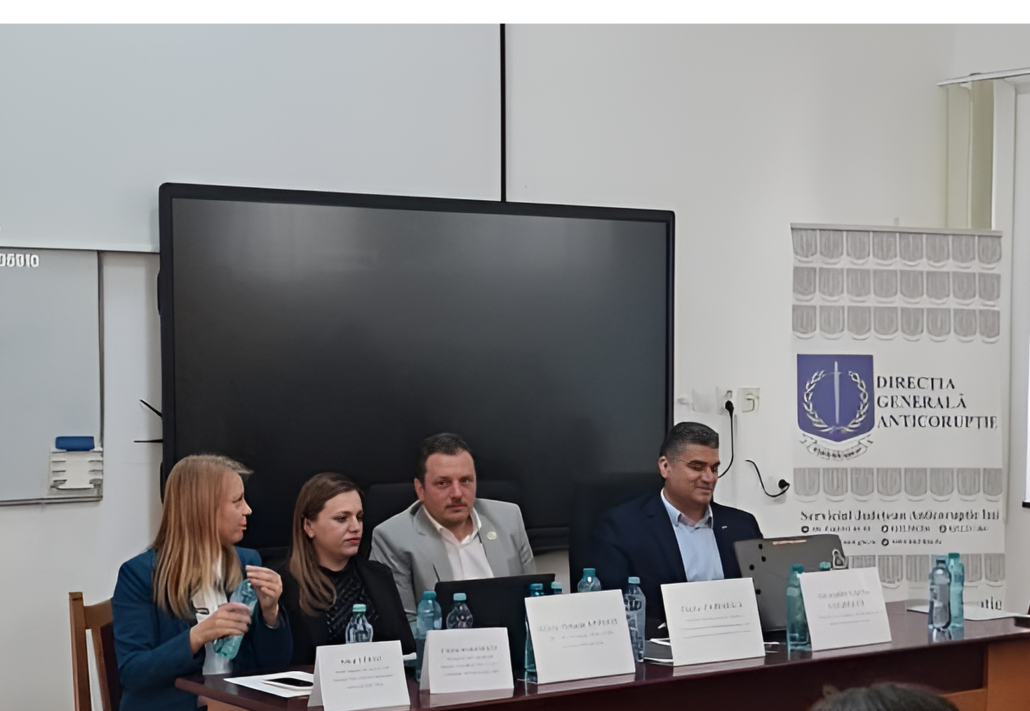
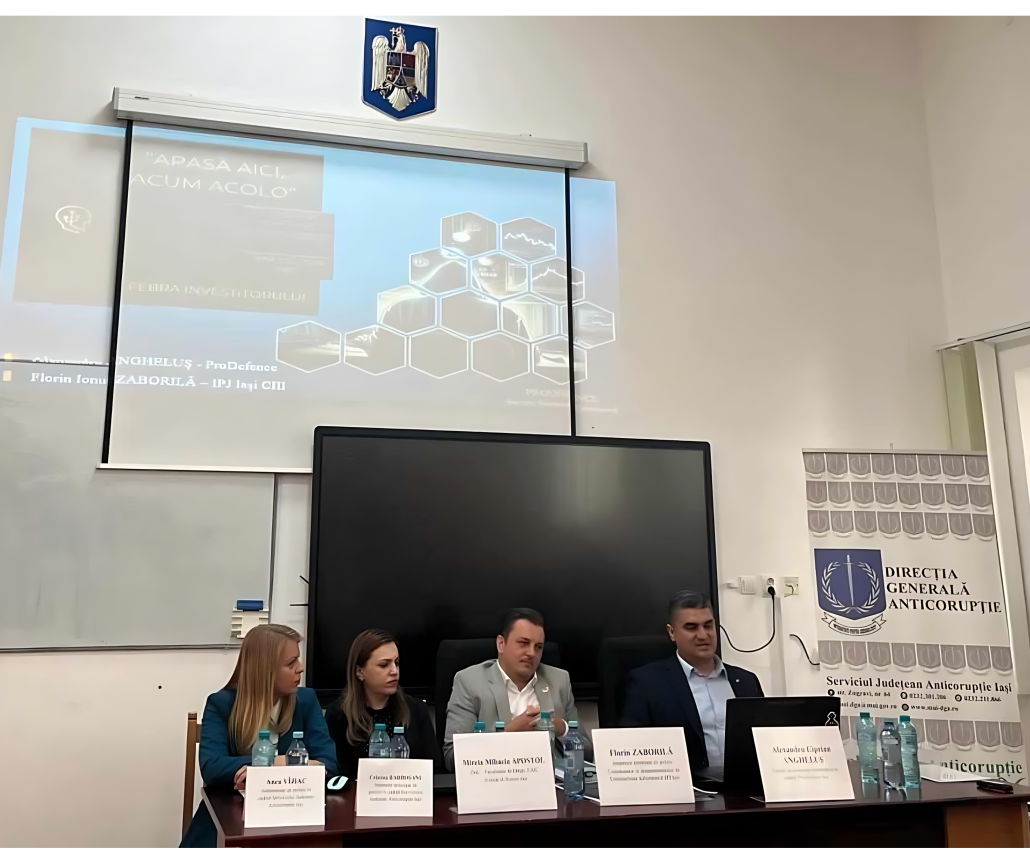
The presentations/discussions on #cybersecurity and #cybercrime always manage to arouse the participants’ curiosity and desire to learn more about cases, investigations, victims, money and criminals.

The Master’s Week, organized by the Law Students Association Iasi, gave us the opportunity to present a small part of the work of investigators of #informatic crimes, underlining the importance of combining legal and technical aspects.


On this occasion I had the pleasure to participate in the presentation prepared by the team of the General Anticorruption Directorate (DGA), Iasi County Anticorruption Service and I can say that I found out extremely important #information.

Thank you to Mr. Inspector Florin Ionut Zaborila, Coordinator of the Computer Crime Investigation Department of IPJ Iași, for his permanent #collaboration and involvement in disseminating information / warnings about the dangers of the online environment!

We thank the organizers and the University “Alexandru Ioan Cuza” of Iași for the invitation!

Presentations/discussions about #cybersecurity and #cybercrime consistently arouse the curiosity of participants and the desire to learn more about cases, investigations, victims, sums of money, and the criminals involved.

The Master’s Week, organized by the Law Students Association – UAIC Iași, provided us with the opportunity to present a small part of the activity of cybercrime investigators, highlighting the importance of combining legal aspects with technical ones.

On this occasion, I had the pleasure of attending the presentation prepared by the team from the General Directorate for Anti-Corruption, Iași County Anti-Corruption Service, and I can say that I learned #extremely important information.

Mr. Chief Inspector Florin ZABORILĂ, Coordinator of the Cybercrime Investigations Department, within the Iași County Police Department, thank you for the ongoing #collaboration and for his involvement in disseminating information/warnings about online threats!
Thank you to the organizers and the “Alexandru Ioan Cuza” University of Iași, for the invitation!

#collaboration #education #cibernetics #warnings #crime #fraud #engagement #collaboration #education #cybernetics #warnings #crime #fraud #involvement

In today’s digital age, safe internet browsing and protecting personal data are top priorities. However, many technology and internet users are unaware of cyber threats and how to protect themselves against them. Fortunately, there are a wide range of cyber education courses available that provide essential information and training to protect your online identity and navigate the digital world safely. Here you will find a detailed analysis of the benefits and content of these courses:

1. Protecting Your Online Identity

The cyber education course usually starts with basics like protecting your online identity. They provide training on how to create strong and unique passwords for each online account, how to use two-factor authentication, and how to be aware of common phishing techniques used by cybercriminals to steal personal information.

2. Prevention of Electronic Fraud

With more and more financial transactions taking place online, it’s crucial to learn how to protect your financial information and identify and avoid scam schemes. Cyber education courses teach you how to protect your credit cards and bank accounts, how to identify unsafe websites and how to avoid becoming a victim of electronic fraud.

3. Safe Internet Surfing

The Internet is full of valuable information, but also of hidden dangers. Cyber education courses give you tips and techniques for safe surfing on the internet, including how to identify and avoid malware-infected websites, how to protect your personal data while surfing online and how to be aware of data privacy threats.

4. Device Security

Our digital devices, such as smartphones and laptops, are often vulnerable to cyber attacks. Cyber education courses teach you how to protect your devices from malware and viruses, how to update your software regularly to prevent security vulnerabilities, and how to be aware of recommended security practices for your digital devices.

5. Updating Knowledge

As technology evolves, so do the methods of cyber attack. Therefore, it is important to keep your knowledge up to date and always be aware of the latest threats and protection techniques. Cyber education courses give you the opportunity to continuously learn and hone your cyber security skills.

Cyber education courses

As far as these cyber education courses are concerned, they are valuable tools for anyone using technology and the internet. By attending these courses, you can gain essential knowledge and skills to protect your online identity and navigate safely in the ever-changing digital world. Don’t underestimate the importance of cyber education in today’s digital age! Investing in cyber education can be the key to protecting your personal information and ensuring a safe and confident online experience.

In today’s digital age, safe internet browsing and protecting personal data are top priorities. However, many technology and internet users are unaware of cyber threats and how to protect themselves against them. Fortunately, there are a wide range of cyber education courses available that provide essential information and training to protect your online identity and navigate the digital world safely. Here you will find a detailed analysis of the benefits and content of these courses:

1. Protecting Your Online Identity

The cyber education course usually starts with basics like protecting your online identity. They provide training on how to create strong and unique passwords for each online account, how to use two-factor authentication, and how to be aware of common phishing techniques used by cybercriminals to steal personal information.

2. Prevention of Electronic Fraud

With more and more financial transactions taking place online, it’s crucial to learn how to protect your financial information and identify and avoid scam schemes. Cyber education courses teach you how to protect your credit cards and bank accounts, how to identify unsafe websites and how to avoid becoming a victim of electronic fraud.

3. Safe Internet Surfing

The Internet is full of valuable information, but also of hidden dangers. Cyber education courses give you tips and techniques for safe surfing on the internet, including how to identify and avoid malware-infected websites, how to protect your personal data while surfing online and how to be aware of data privacy threats.

4. Device Security

Our digital devices, such as smartphones and laptops, are often vulnerable to cyber attacks. Cyber education courses teach you how to protect your devices from malware and viruses, how to update your software regularly to prevent security vulnerabilities, and how to be aware of recommended security practices for your digital devices.

5. Updating Knowledge

As technology evolves, so do the methods of cyber attack. Therefore, it is important to keep your knowledge up to date and always be aware of the latest threats and protection techniques. Cyber education courses give you the opportunity to continuously learn and hone your cyber security skills.

Cyber education courses

As far as these cyber education courses are concerned, they are valuable tools for anyone using technology and the internet. By attending these courses, you can gain essential knowledge and skills to protect your online identity and navigate safely in the ever-changing digital world. Don’t underestimate the importance of cyber education in today’s digital age! Investing in cyber education can be the key to protecting your personal information and ensuring a safe and confident online experience.

Strategic considerations, operational risks and security requirements in an emerging cyber-physical ecosystem

The integration of drones (UAVs – Unmanned Aerial Vehicles) into civilian, commercial and government operational processes is one of the most accelerated technological transitions of the last decade. From inspection and monitoring activities, to critical security, logistics or data collection operations, UAVs have become indispensable tools in many sectors.

However, this rapid adoption has been dominated by considerations of efficiency, cost and technological capability, to the detriment of a systematic assessment of security risks. In many cases, drones are treated as ancillary equipment, without being formally integrated into cybersecurity architecture, risk management processes, or critical infrastructure protection policies.

In reality, drones are complex cyber-physical platforms that extend the attack surface of organizations beyond the traditional digital perimeter. In this context, the development of a structured Drone Cybersecurity & Counter-Drone Awareness approach  is no longer optional, but an essential condition for maintaining security, operational continuity and institutional trust.

1. Drone cybersecurity as a strategic priority

1.1. UAVs as extensions of digital infrastructure

From a functional point of view, a modern drone must be understood as a distributed system, consisting of:

  • specialized hardware components (flight controllers, sensors, propulsion systems);
  • navigation and positioning systems (GNSS, INS, inertial sensors);
  • radio and IP communication channels;
  • firmware and control software;
  • management applications and cloud backends for data processing and storage.

This architecture makes UAVs comparable to critical IoT equipment or connected industrial systems. Any vulnerability exploited at the level of communication, firmware or control interfaces can lead to the compromise of the entire mission and, implicitly, to physical and operational effects.

1.2. Convergence of cyber, physical and operational risks

Unlike many classic IT assets, drones generate a direct convergence between cyber and physical risk. A security incident is not limited to data loss or unavailability of a service, but can cause:

  • intrusions into sensitive spaces;
  • affect the safety of staff and the public;
  • disruption of critical infrastructure;
  • severe reputational impact and legal consequences.

This convergence requires a paradigm shift: drone security cannot be treated exclusively as a technical issue, but as an integrated component of organisational and national security.

1.3. Common systemic vulnerabilities

The analysis of incidents and current practices highlights a number of recurring vulnerabilities:

  • lack of independent auditing of firmware and software ecosystems;
  • reliance on mobile applications and cloud services with varying levels of security;
  • insecure default configurations and weak authentication mechanisms;
  • the absence of clear policies for the use, monitoring and response to UAV incidents.

These elements create a favourable context for exploitation, both by opportunistic and advanced actors, in coordinated campaigns.

2. Cyberattack vectors specific to UAV ecosystems

2.1. Compromising communications and navigation

The communication channels between the drone, the control station and the backend infrastructure are one of the most exposed points of the system. Attacks can target:

  • interception of traffic for the collection of operational information;
  • injection of unauthorized orders;
  • deliberate degradation of the control link by jamming;
  • manipulation of navigation systems through spoofing techniques.

The consequences are not limited to loss of control, but may include compromising the integrity of the data collected and misleading decision-making processes based on that data.

2.2. Software and firmware vulnerabilities

UAV ecosystems are generally based on proprietary software, with little visibility into internal security mechanisms. Risks include:

  • firmware implementation errors;
  • Insufficiently secure management interfaces or APIs
  • update mechanisms vulnerable to supply chain attacks;
  • Uncontrolled integration with third-party apps.

Exploiting these vulnerabilities can allow attackers to achieve persistence, manipulate drone operation, or exfiltrate sensitive data without being detected.

2.3. Attacks on data and processing infrastructure

Drones are essentially data collection platforms. Attacks can target:

  • interception of video streams or telemetry;
  • compromise of storage systems;
  • alteration or falsification of the collected data;
  • deleting or modifying flight logs to hide malicious activity.

In sensitive contexts, these attacks can affect investigations, audit processes, or can be used for information manipulation.

2.4. Exploitation of the human factor

UAV operators are a critical component of the security chain. Phishing, social engineering, or targeted malware attacks can result in:

  • compromise of control accounts;
  • unauthorized access to associated cloud platforms;
  • manipulation of flight configurations or plans;
  • facilitating subsequent attacks on the organization’s infrastructure.

3. Drones in hybrid threat architecture

3.1. UAVs as reconnaissance and intelligence tools

Within hybrid threats, drones are used to gain a detailed understanding of the target environment: infrastructures, procedures, operational flows and personnel behavior. The information collected can be correlated with OSINT data and other sources to build detailed target profiles.

3.2. Integration of drones in cyber-physical attacks

Drones can support or amplify cyberattacks by:

  • identification of vulnerable points of the physical infrastructure;
  • deliberately disrupting systems to create windows of opportunity;
  • synchronizing physical incidents with digital attacks to maximize impact.

This integration makes detecting and attributing attacks considerably more difficult.

3.3. The informational and psychological dimension

The visual materials collected with the help of drones can be used to create or sustain manipulative narratives. Even without advanced technical changes, taking images out of context or selectively presenting images can generate confusion, mistrust and public pressure on institutions.

4. Counter-Drone Awareness: from reaction to institutional capacity

4.1. The importance of organizational awareness

The first level of countermeasures is the recognition that drones can pose a risk. This involves:

  • identification of sensitive areas and assets;
  • understanding the types of legitimate UAV activities in proximity;
  • defining the criteria for classifying a UAV incident.

4.2. Processes, responsibilities and institutional integration

A mature approach requires clear reporting, analysis and escalation procedures in place, integrated into existing security and business continuity systems. Roles and responsibilities must be explicitly defined and cooperation with competent authorities must be established in advance.

4.3. Detection and analysis capabilities

Sensing technologies (RF, radar, acoustics, EO/IR) should be seen as decision-support tools, not as stand-alone solutions. Real value comes from data correlation, contextualization, and integration with cybersecurity and intelligence platforms.

4.4. Legal constraints

It is essential for organizations to understand the legal limits of intervention. Active neutralization measures are strictly regulated, and the role of private entities focuses on detection, documentation and institutional cooperation.

5. Building a Coherent Drone Cybersecurity Strategy

An effective strategy must include:

  • clear governance and internal policies;
  • integration of UAVs in risk and incident management;
  • technical measures proportionate to the level of risk;
  • training and awareness programs;
  • alignment with existing information and operational security frameworks.

This approach ensures not only the reduction of risks, but also the increase of organizational resilience in the face of complex and constantly evolving threats.

Drones are a capability multiplier, but also a risk multiplier. In the absence of a structured approach, they can become critical points of vulnerability in an already complex security landscape.

Drone Cybersecurity & Counter-Drone Awareness should not be seen as separate areas, but as interdependent elements of a modern cyber-physical security architecture. Organizations that invest in understanding, processes, and capabilities today will be significantly better prepared for the operational challenges of the next decade.

A particular feature of today’s financial fraud is the ability of criminals to adapt quickly to new technologies and trends. In an increasingly connected world, where more and more transactions take place online, criminals have developed the ability to quickly exploit any vulnerability. This includes using social networks to spread fake investment schemes, compromising the security of mobile apps for unauthorised access to bank accounts, and even exploiting emerging technologies such as cryptocurrency and blockchain to devise new types of scams.

Meet Jamie and the World of the Internet

Hey kids! Let’s talk about Jamie, who’s a lot like you. Jamie loves playing games, chatting with friends, and exploring the internet. But one day, Jamie got an email from someone he didn’t know, offering a free gift in exchange for some personal details. Hmm, what do you think Jamie should do? Should he share his information for a gift?

The Secret Code of Cybersecurity

Cybersecurity is like having a secret code that keeps your treasure chest of personal information safe. It’s all about protecting your details from people who might use them in the wrong way. Imagine your personal information is a treasure, and cybersecurity is the code that locks it up safely.

The Power of Passwords

Do you have a secret code, or a password, for your games or apps? How many of you use the same password for everything? It might be easy to remember, but it’s like having one key for every lock in your house. If someone finds that key, they can open everything! What if we make unique and strong passwords for each account? A strong password is like a strong castle – the more complex it is, the harder it is for hackers to break in.

Stranger Danger Online

Now, imagine you’re playing your favorite online game, and someone asks for your address to send you a game accessory. Is that safe? Just like in real life, not everyone online is friendly. Sharing personal details, like where you live or your school name, can be risky. It’s better to keep some things a secret on the internet.

Beware of Tricky Gifts and Prizes

Remember the email Jamie got? Offers for free gifts or prizes can be exciting, but they can also be tricks called phishing attempts. Hackers use these to get your personal information. When you get messages like these, should you click on links or download things? Nope! It’s best to ignore them and tell an adult you trust.

Be a Cybersecurity Superhero

Cybersecurity might sound complicated, but it’s really about making smart choices to keep your information safe. Just like you wouldn’t share a secret with a stranger, don’t share personal info online without thinking. Next time you’re entering a password, sharing details, or about to click a link, stop and think: is this safe? And if you’re not sure, always ask a grown-up you trust.

So, are you ready to be a cybersecurity superhero, guarding your personal info from the internet’s villains? Your smart actions can help keep the internet a fun and safe place for everyone! 🌐🔒🦸‍♀️🦸‍♂️

The Magical Digital Ocean

Hey there, young explorers! Do you know why your parents and teachers often remind you to be careful on the internet? It’s because the online world is like a vast, magical ocean. It’s full of wonders and fun, but just like a real ocean, it has some hidden dangers. Let’s dive into an exciting story about a little fish named Fin and learn how to safely navigate this digital ocean.

Fin’s Exciting Discovery

Meet Fin, a bright-eyed, curious fish who loved exploring. One day, while swimming through the ocean, Fin discovered a new, dazzling area. It was filled with colorful corals and friendly fishes, much like when you discover a new game or social media app on the internet. Fin was thrilled, but he remembered something important – he needed to explore this new place carefully and wisely.

Balancing Time

Fin enjoyed exploring this vibrant part of the ocean, but he knew he couldn’t stay there forever. He had other things to do – like going back to his cozy coral home, eating his favorite seaweed snacks, and resting. This is just like how you have schoolwork, playtime with friends, and bedtime. Fin’s adventure teaches us that it’s important to balance our time online with other important activities in our lives.

Celebrating Uniqueness

In this new, exciting part of the ocean, Fin met many different fishes. Some were bigger, some shone brighter, but Fin realized something special – he was unique in his own way, and that was awesome! Just like Fin, you should always remember that you are special and unique. Don’t compare yourself to others you see online. Everyone is different, and that’s what makes the world so interesting!

The Power of Kind Words

Fin learned to communicate with the other sea creatures respectfully. He knew that words, like water currents, could be gentle or strong. He chose to use gentle, kind words. This is called good online manners, or ‘online etiquette.’ It’s really important to remember to be kind and polite when you’re chatting, commenting, or playing games on the internet.

The Joy of Unplugging

Fin was a wise little fish. He knew that spending too much time in this new, enchanting part of the ocean could be overwhelming. So, he made a smart choice – to take breaks and spend time with his family and friends. Just like Fin, it’s good for us to unplug from the digital world now and then. Playing outside, reading books, or spending time with family helps us stay happy and healthy.

Safe and Happy Exploring

From Fin’s adventure, we learn some important lessons: set time limits for using the internet, celebrate our uniqueness, be kind online, and take breaks to enjoy the world around us. The internet is a fantastic place to learn and play, but we must explore it safely and happily, just like Fin did in his ocean.

So, kids, remember to swim safely in the digital ocean. Explore, learn, and have fun, but always be like Fin – smart, kind, and careful! 🌟🐠🌐🎮📚

Introduction: Navigating the Digital Landscape

In an era where digital technology permeates every aspect of our lives, the importance of cyber security has never been more pronounced. This article, designed as a companion piece to our informative video, delves into the critical need for cyber security education in our increasingly connected world. We aim to shed light on the alarming trends in cybercrime and emphasize how enhanced knowledge and awareness are pivotal in safeguarding our digital existence.

Understanding the Cyber Threat Landscape

Cybercrime statistics paint a daunting picture, signaling an urgent need for action. Daily, millions fall prey to a variety of cyber threats, ranging from identity theft to sophisticated financial scams. This section, echoing our video’s content, provides a detailed analysis of current cybercrime trends. It aims to offer readers a comprehensive understanding of the risks prevalent in the digital space, highlighting why no individual or entity is immune to these threats.

The Transformative Power of Cyber Security Education

Central to both our video and this article is the concept that cyber security education is a key to a much-needed digital vault. This segment explores how education is a vital defense mechanism, empowering individuals and organizations to protect sensitive data and digital identities. It’s essential for everyone, from CEOs to everyday internet users, to understand cyber security principles. This knowledge is crucial in maintaining privacy, ensuring data integrity, and safeguarding client confidentiality.

Practical Strategies for Enhancing Digital Safety

Expanding on the video’s insights, this section offers practical strategies and best practices for digital safety. It covers a range of topics from fundamental practices like robust password protocols to advanced security measures such as multi-factor authentication and regular software updates. The aim is to provide readers with actionable steps to enhance their digital security, reducing susceptibility to online scams and cyber attacks.

Conclusion: Embracing Cyber Security Education as a Necessity

We conclude by reemphasizing the video’s core message: cyber security education is not merely a choice but a vital investment in personal and professional safety. In the digital battle against cyber threats, being informed and proactive is the best defense. By arming oneself with knowledge and the right tools, one can create a safer digital future.

Call to Action: Join the Movement with Prodefence

We encourage our readers to engage actively in cyber security education. With Prodefence, you gain access to a wealth of resources and expert insights, enabling you to navigate the complexities of cyber security with confidence. Remember, in the cyber world, knowledge is not just power – it’s protection. Join Prodefence in championing cyber security education and take a significant step towards securing your digital life.


Analysis of a complex and effective cyber-attack

Angheluș AlexandruProdefence
Oana BuzianuWintech

Nowaday’s digital society needs continued availability of services and effective protection of sensitive data. Information assets and online services are very important for all organisations and vital for creating a secure digital economy.

Although cyberattacks target every industry, the financial sector is disproportionately affected, being vulnerable to many increasingly sophisticated threats, as cybercriminals know that they have access to large sums that self-finance their criminal activities. Cybersecurity in banking organizations has become increasingly critical.

The stakes rise when we talk about the confidentiality, integrity and availability of information assets, as well as the implementation of state-of-the-art services and applications (Fintech, Blockchain), which lead to improved resilience against cyber threats. The financial sector recognises the evolution of cyber threats and risks, as well as the ever-changing pace of technology.

As with other information infrastructures, some of the decisions and solutions adopted by the management cannot be based strictly on policies and procedures, but are based on cybersecurity incidents with an impact on their own institutions, or analyzes / reports of cybersecurity experts.

All this underlines the need to protect data and transactions in sensitive data and therefore to (re)ensure trust in the financial sector. This analysis is about an extremely complex cyberattack with a very high criminal activity, although everything starts from a simple information found on one of the platforms monitored by the ProWin team.