Apply AI Alliance of the European Commission accepts three ProDefence publications on artificial intelligence
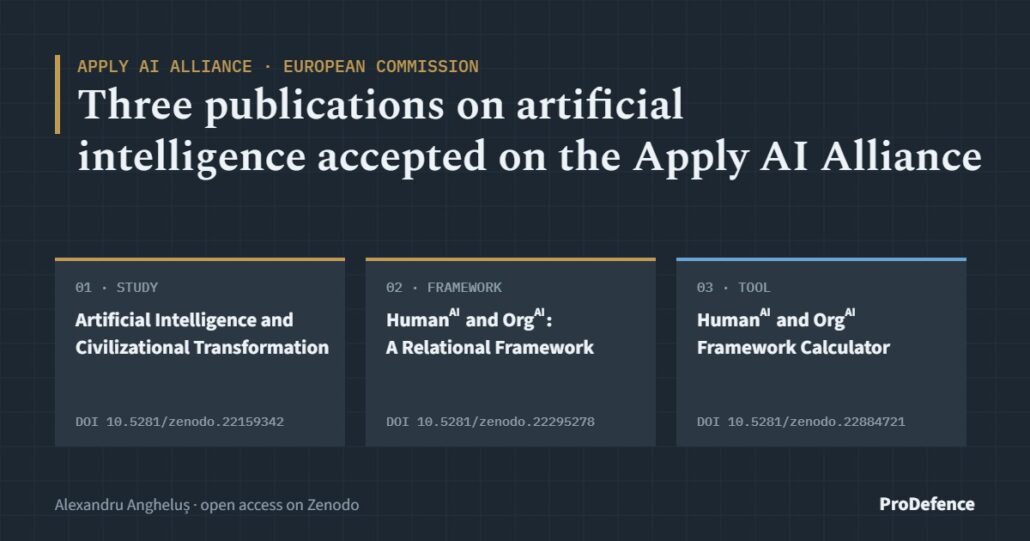
Three research publications by Alexandru Angheluș, published under the ProDefence umbrella, have been accepted and, since 28 September 2026, appear in the community space of the Apply AI Alliance, the European Commission’s forum for artificial intelligence policy. They are the study “Artificial Intelligence and Civilizational Transformation”, the conceptual framework “HumanAI and OrgAI: A Relational Framework for AI-Mediated Human and Organizational Capacity”, and the software tool that puts it into practice, the “HumanAI and OrgAI Framework Calculator”.
Together they form a complete path: a broad analysis of the changes artificial intelligence is driving, a conceptual framework that makes those changes measurable at the level of a person and of an organization, and a tool that turns the framework into reproducible assessments. All three are open access, with permanent DOI identifiers on Zenodo.
What the Apply AI Alliance is
The Apply AI Alliance is the coordination forum between artificial intelligence stakeholders and European policy makers, run by the European Commission’s Directorate-General for Communications Networks, Content and Technology (DG CONNECT). It builds on the former European AI Alliance and supports the governance of the Apply AI Strategy, through which the European Union aims to accelerate the uptake of artificial intelligence in strategic sectors of the economy and in the public sector.
The platform, hosted on Futurium, brings together companies, universities, research organizations, public authorities, civil society organizations and citizens. Community content can only be posted by accepted members of the community, and the material is read by the people who actually work on European AI policy.
The three publications
1. Artificial Intelligence and Civilizational Transformation
The study starts from a simple observation: artificial intelligence is no longer just a technology that automates tasks. It is becoming part of the operational environment of human and institutional life. Decisions in the economy, education, security and public administration are increasingly prepared, filtered or proposed by artificial systems. The author calls this stage “the era of synthetic decision”.
The analysis introduces the concept of the “cognitively assisted Earth”, meaning the integration of artificial intelligence into the operating infrastructure of society, and the relational notation HumanAI and OrgAI for people and organizations whose capabilities, vulnerabilities and decisions are mediated by artificial systems. The method is qualitative and interdisciplinary, combining conceptual analysis, case studies from the European Union and the United States, chapters on AI governance and geopolitics, and prospective scenarios.
Its conclusion moves the question from “whether” to “how”: the transformation is happening regardless, and what is at stake is whether it remains intelligible, governable, equitable and compatible with the material limits of the Earth. The study has an English and a Romanian edition, with 32 charts.
- On the Apply AI Alliance: Artificial Intelligence and Civilizational Transformation
- English edition: DOI 10.5281/zenodo.22159342
- Romanian edition: DOI 10.5281/zenodo.22162165
- On this site: “Transformation”: AI, human autonomy and the cognitively assisted Earth
2. HumanAI and OrgAI: the relational framework
The second publication turns the notation from the first into a rigorous conceptual framework. HumanAI describes a person, AI system, task and context configuration in which an AI system materially changes a person’s performance, judgment, learning or vulnerability. OrgAI describes the governed socio-technical framework through which an organization integrates human-AI episodes, systems, institutional knowledge, roles, processes, validation, traceability, security and controlled learning.
The distinction matters for any organization adopting artificial intelligence. An employee can become far more productive with an AI assistant without the organization gaining anything durable: when the person leaves or the tool changes, the capacity is gone. The framework sets precise construct boundaries and offers formal and relational models, testable propositions, and methods for classification, measurement, governance and implementation.
A central concept is epistemic decoupling: the situation in which AI-assisted outputs improve while the person’s understanding of them does not keep pace. The organization looks more competent than it is, and the risk only becomes visible when the system gets something wrong and nobody is able to check it.
- On the Apply AI Alliance: HumanAI and OrgAI: A Relational Framework
- On Zenodo: DOI 10.5281/zenodo.22295278
- On this site: HumanAI and OrgAI: what capacity has the organisation built
3. HumanAI and OrgAI Framework Calculator
The third publication is the applied part: a software tool that operationalizes the relationships defined in the framework. Version 1.2.0 structures an assessment across six components: epistemic decoupling, propagation exposure, the constitutive threshold, the material contribution of the AI system, relational synergy, and maturity classification.
The calculator produces reproducible assessment records that can be reloaded, verified and contested by other parties. It runs entirely in the user’s browser, with no accounts, no database and no data transmission, including on isolated networks. It uses a versioned, backward-compatible JSON schema and ships with embedded tests that validate the implemented logic.
- On the Apply AI Alliance: HumanAI and OrgAI Framework Calculator
- On Zenodo: DOI 10.5281/zenodo.22884721
- On this site: The HumanAI and OrgAI Framework Calculator, version 1.2.0 and a guided tour of the calculator
From analysis to instrument
The three works answer three different questions in turn. The first asks what changes when human and institutional decisions come to be mediated by artificial systems. The second asks how that mediation can be described precisely enough to be compared and measured. The third asks how an organization can assess it in practice, in a way a third party can verify.
That sequence matters in a forum like the Apply AI Alliance. The European debate on artificial intelligence has moved from rules to adoption, and adoption raises a problem that ordinary indicators miss: the difference between using a tool and building a capability. The number of licences purchased or employees trained does not tell you whether the organization understands, controls and can verify what it produces with AI.
The link with European requirements
Regulation (EU) 2024/1689, the AI Act, requires providers and deployers to ensure a sufficient level of AI literacy among their staff (Article 4) and imposes human oversight for high-risk systems (Article 14). Both requirements assume that people can understand and check what the systems produce, which is precisely the phenomenon the HumanAI and OrgAI framework calls epistemic decoupling.
The framework is not a compliance tool and does not replace the assessments required by law. It does offer a shared vocabulary and a reproducible method through which an organization can document whether integrating artificial intelligence has increased its real capacity or only its dependence on a vendor.
Open access and licensing
All three publications are freely available on Zenodo with permanent DOI identifiers. The studies and the conceptual framework are published under the Creative Commons Attribution-NoDerivatives 4.0 International licence (CC BY-ND 4.0). The calculator’s code is released under the MIT licence, held by S.C. PRODEFENCE S.R.L., which allows free reuse, including in institutional settings.
The full list of publications is on the Research and innovation page.
Frequently asked questions
What is the Apply AI Alliance?
The Apply AI Alliance is the European Commission’s coordination forum between artificial intelligence stakeholders and policy makers. It builds on the former European AI Alliance, is run by DG CONNECT and supports the governance of the Apply AI Strategy, which focuses on the uptake of artificial intelligence in strategic sectors.
Which three publications were accepted?
“Artificial Intelligence and Civilizational Transformation” (DOI 10.5281/zenodo.22159342), “HumanAI and OrgAI: A Relational Framework for AI-Mediated Human and Organizational Capacity” (DOI 10.5281/zenodo.22295278) and the “HumanAI and OrgAI Framework Calculator” version 1.2.0 (DOI 10.5281/zenodo.22884721), all by Alexandru Angheluș.
What do HumanAI and OrgAI mean?
HumanAI is a configuration in which an AI system materially changes a person’s performance, judgment, learning or vulnerability in a given task and context. OrgAI is the governed socio-technical framework through which an organization turns those episodes into durable institutional capacity.
What is epistemic decoupling?
It is the situation in which AI-assisted results improve while the person’s understanding and ability to verify them do not keep pace. The organization appears more competent than it is, and the risk becomes visible only when the system makes a mistake.
Does the calculator send data to a server?
No. The calculator runs entirely in the browser, requires no account, has no database and can work on isolated networks. Results are saved locally as JSON files that can be reloaded and verified.
Can I use these works freely?
Yes. The studies are open access under CC BY-ND 4.0, which allows redistribution with attribution, without changes to the text. The calculator’s code is under the MIT licence.
