Three research publications by Alexandru Angheluș, published under the ProDefence umbrella, have been accepted and, since 28 September 2026, appear in the community space of the Apply AI Alliance, the European Commission’s forum for artificial intelligence policy. They are the study “Artificial Intelligence and Civilizational Transformation”, the conceptual framework “HumanAI and OrgAI: A Relational Framework for AI-Mediated Human and Organizational Capacity”, and the software tool that puts it into practice, the “HumanAI and OrgAI Framework Calculator”.
Interactive guide
The HumanAI and OrgAI calculator, layer by layer: the inputs, the evidence rule, modules 01–07, the ten-predicate detector and the export gate, with formulas and four computations you can run on the page.
The HumanAI and OrgAI framework, layer by layer: the foundations, the individual configuration, the membership test, the Iorg threshold, epistemic decoupling, maturity M0–M5 and governance, with four computations you can run directly on the page.
Together they form a complete path: a broad analysis of the changes artificial intelligence is driving, a conceptual framework that makes those changes measurable at the level of a person and of an organization, and a tool that turns the framework into reproducible assessments. All three are open access, with permanent DOI identifiers on Zenodo.
What the Apply AI Alliance is
The Apply AI Alliance is the coordination forum between artificial intelligence stakeholders and European policy makers, run by the European Commission’s Directorate-General for Communications Networks, Content and Technology (DG CONNECT). It builds on the former European AI Alliance and supports the governance of the Apply AI Strategy, through which the European Union aims to accelerate the uptake of artificial intelligence in strategic sectors of the economy and in the public sector.
The platform, hosted on Futurium, brings together companies, universities, research organizations, public authorities, civil society organizations and citizens. Community content can only be posted by accepted members of the community, and the material is read by the people who actually work on European AI policy.
The three publications
1. Artificial Intelligence and Civilizational Transformation
The study starts from a simple observation: artificial intelligence is no longer just a technology that automates tasks. It is becoming part of the operational environment of human and institutional life. Decisions in the economy, education, security and public administration are increasingly prepared, filtered or proposed by artificial systems. The author calls this stage “the era of synthetic decision”.
The analysis introduces the concept of the “cognitively assisted Earth”, meaning the integration of artificial intelligence into the operating infrastructure of society, and the relational notation HumanAI and OrgAI for people and organizations whose capabilities, vulnerabilities and decisions are mediated by artificial systems. The method is qualitative and interdisciplinary, combining conceptual analysis, case studies from the European Union and the United States, chapters on AI governance and geopolitics, and prospective scenarios.
Its conclusion moves the question from “whether” to “how”: the transformation is happening regardless, and what is at stake is whether it remains intelligible, governable, equitable and compatible with the material limits of the Earth. The study has an English and a Romanian edition, with 32 charts.
The second publication turns the notation from the first into a rigorous conceptual framework. HumanAI describes a person, AI system, task and context configuration in which an AI system materially changes a person’s performance, judgment, learning or vulnerability. OrgAI describes the governed socio-technical framework through which an organization integrates human-AI episodes, systems, institutional knowledge, roles, processes, validation, traceability, security and controlled learning.
The distinction matters for any organization adopting artificial intelligence. An employee can become far more productive with an AI assistant without the organization gaining anything durable: when the person leaves or the tool changes, the capacity is gone. The framework sets precise construct boundaries and offers formal and relational models, testable propositions, and methods for classification, measurement, governance and implementation.
A central concept is epistemic decoupling: the situation in which AI-assisted outputs improve while the person’s understanding of them does not keep pace. The organization looks more competent than it is, and the risk only becomes visible when the system gets something wrong and nobody is able to check it.
The third publication is the applied part: a software tool that operationalizes the relationships defined in the framework. Version 1.2.0 structures an assessment across six components: epistemic decoupling, propagation exposure, the constitutive threshold, the material contribution of the AI system, relational synergy, and maturity classification.
The calculator produces reproducible assessment records that can be reloaded, verified and contested by other parties. It runs entirely in the user’s browser, with no accounts, no database and no data transmission, including on isolated networks. It uses a versioned, backward-compatible JSON schema and ships with embedded tests that validate the implemented logic.
The three works answer three different questions in turn. The first asks what changes when human and institutional decisions come to be mediated by artificial systems. The second asks how that mediation can be described precisely enough to be compared and measured. The third asks how an organization can assess it in practice, in a way a third party can verify.
That sequence matters in a forum like the Apply AI Alliance. The European debate on artificial intelligence has moved from rules to adoption, and adoption raises a problem that ordinary indicators miss: the difference between using a tool and building a capability. The number of licences purchased or employees trained does not tell you whether the organization understands, controls and can verify what it produces with AI.
The link with European requirements
Regulation (EU) 2024/1689, the AI Act, requires providers and deployers to ensure a sufficient level of AI literacy among their staff (Article 4) and imposes human oversight for high-risk systems (Article 14). Both requirements assume that people can understand and check what the systems produce, which is precisely the phenomenon the HumanAI and OrgAI framework calls epistemic decoupling.
The framework is not a compliance tool and does not replace the assessments required by law. It does offer a shared vocabulary and a reproducible method through which an organization can document whether integrating artificial intelligence has increased its real capacity or only its dependence on a vendor.
Open access and licensing
All three publications are freely available on Zenodo with permanent DOI identifiers. The studies and the conceptual framework are published under the Creative Commons Attribution-NoDerivatives 4.0 International licence (CC BY-ND 4.0). The calculator’s code is released under the MIT licence, held by S.C. PRODEFENCE S.R.L., which allows free reuse, including in institutional settings.
The topic of AI governance continues on CysAI, the ProDefence platform that tracks AI regulation across more than 15 jurisdictions and publishes risk profiles for AI agents.
Frequently asked questions
What is the Apply AI Alliance?
The Apply AI Alliance is the European Commission’s coordination forum between artificial intelligence stakeholders and policy makers. It builds on the former European AI Alliance, is run by DG CONNECT and supports the governance of the Apply AI Strategy, which focuses on the uptake of artificial intelligence in strategic sectors.
Which three publications were accepted?
“Artificial Intelligence and Civilizational Transformation” (DOI 10.5281/zenodo.22159342), “HumanAI and OrgAI: A Relational Framework for AI-Mediated Human and Organizational Capacity” (DOI 10.5281/zenodo.22295278) and the “HumanAI and OrgAI Framework Calculator” version 1.2.0 (DOI 10.5281/zenodo.22884721), all by Alexandru Angheluș.
What do HumanAI and OrgAI mean?
HumanAI is a configuration in which an AI system materially changes a person’s performance, judgment, learning or vulnerability in a given task and context. OrgAI is the governed socio-technical framework through which an organization turns those episodes into durable institutional capacity.
What is epistemic decoupling?
It is the situation in which AI-assisted results improve while the person’s understanding and ability to verify them do not keep pace. The organization appears more competent than it is, and the risk becomes visible only when the system makes a mistake.
Does the calculator send data to a server?
No. The calculator runs entirely in the browser, requires no account, has no database and can work on isolated networks. Results are saved locally as JSON files that can be reloaded and verified.
Can I use these works freely?
Yes. The studies are open access under CC BY-ND 4.0, which allows redistribution with attribution, without changes to the text. The calculator’s code is under the MIT licence.
Every screenshot is real, produced by running the instrument. The data in them is the illustrative example the calculator opens with, not any client’s data. The interface is in English.
What it is, in two sentences
The calculator is the digital instrument that accompanies the whitepaper “HumanAI and OrgAI: A Relational Framework for AI-Mediated Human and Organizational Capacity”. It turns the relationships defined there into an assessment record you complete for a concrete situation, one process, one team, one observation period, and which someone else can then verify, challenge and repeat.
A single HTML file. No installation, no account, no server, and no network request of any kind.
Interactive guide
The HumanAI and OrgAI calculator, layer by layer: the inputs, the evidence rule, modules 01–07, the ten-predicate detector and the export gate, with formulas and four computations you can run on the page.
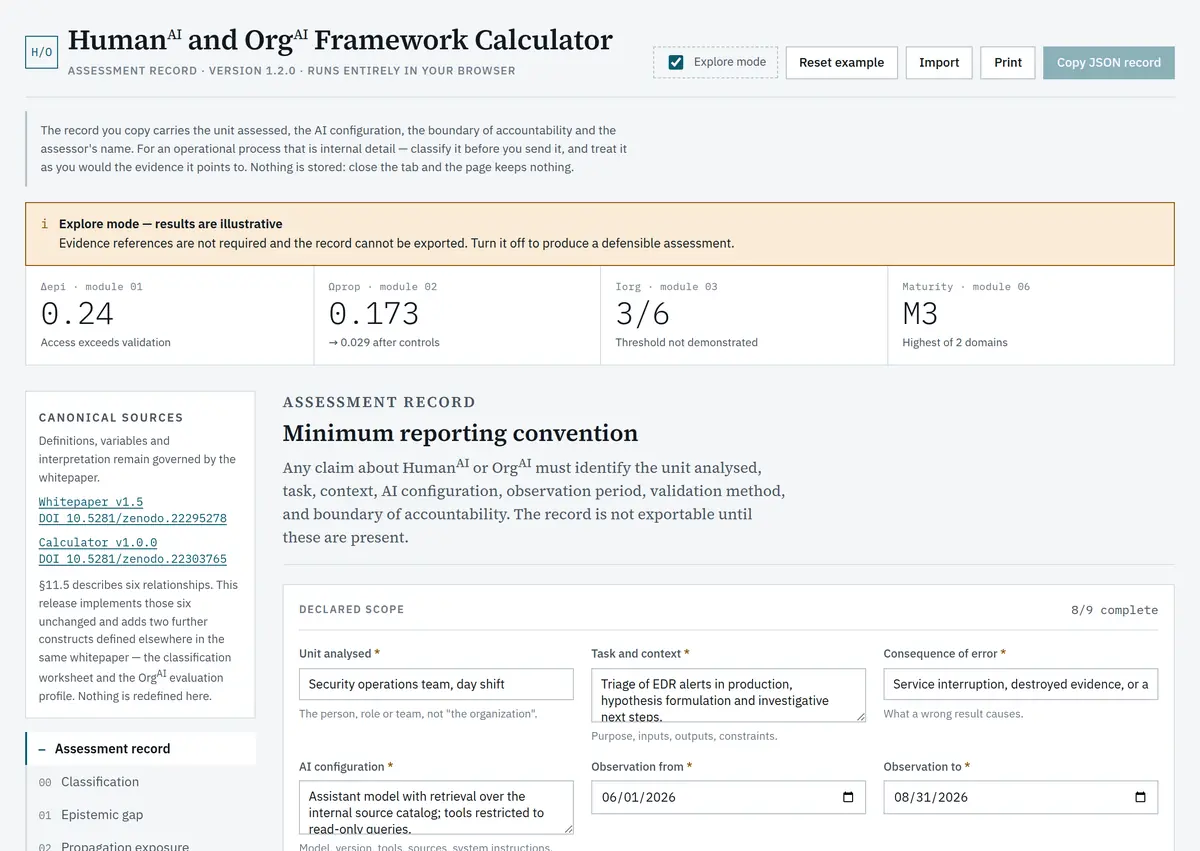
Figure 1. The opening screen. Action bar at the top, results strip beneath it, module navigation on the left.
It opens with a worked example, the illustrative case from the whitepaper, so you can see immediately how it behaves rather than facing an empty form. The “Reset example” button brings it back at any time.
Three zones, from top to bottom:
The action bar: the switch between working modes, resetting the example, importing a record, printing and copying the record.
The results strip: the four figures that summarise the assessment, the epistemic gap, propagation exposure, the organisational threshold and maturity. They stay visible whichever module is open.
The workspace: module navigation on the left, the active module on the right.
Navigation: eight modules and a diagnostic
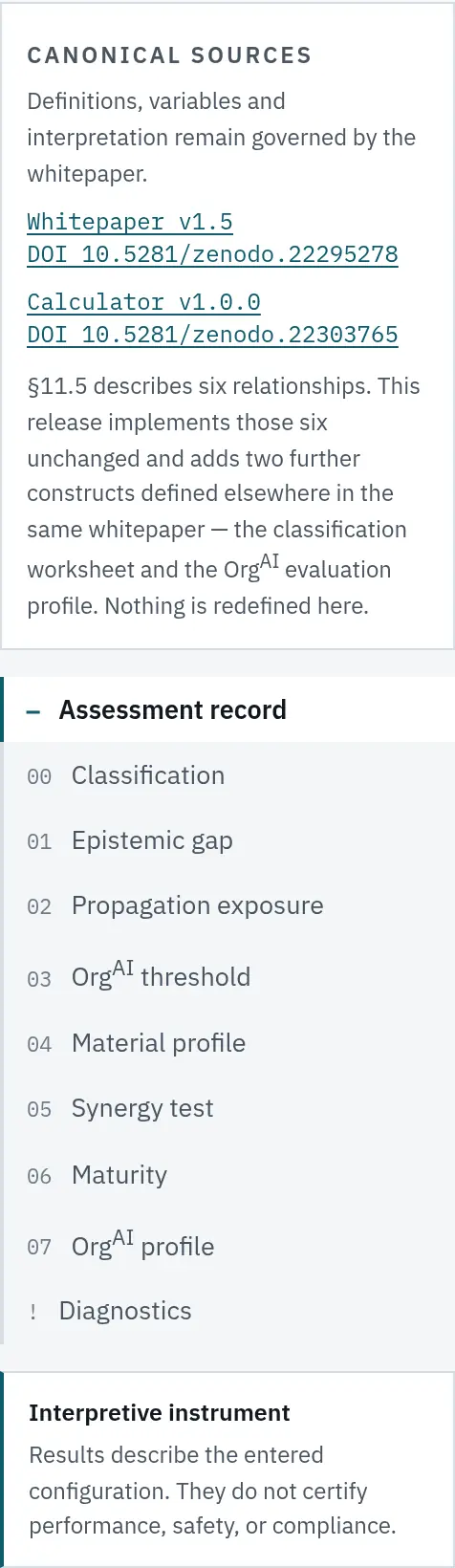
Figure 2. The navigation column. The orange dot marks a module that has something to resolve.
The modules are a sequence rather than a menu. Module 02 consumes the result of 01. Module 06 depends on 03. The classification worksheet, module 00, can stop everything else if the situation is not a HumanAI case.
The orange dots next to modules are a status signal: an incomplete record, conditions declared without evidence, a single dimension marked relevant, active diagnostic flags. You do not have to enter every module to find out where you still owe something.
At the bottom sit the canonical sources with the DOIs of the whitepaper and of the instrument, plus the note explaining the relationship between the current version and section 11.5 of the whitepaper.
Two working modes
The distinction between exploring and assessing is explicit, because mixing the two is the usual way results are produced that look like an assessment without being one.
Figure 3. Exploration mode: results are marked illustrative, export is disabled.
In exploration mode you can move every value freely to see how the relationships behave. Evidence references are not required, and the record cannot be exported. Someone who only wants to understand the formula is not forced to complete a full record; in exchange, they cannot accidentally produce an artefact that looks like an assessment.
Figure 4. The action bar in exploration mode: the copy button is inactive.
Clear the checkbox and the instrument becomes demanding.
The record: what must be declared before any number
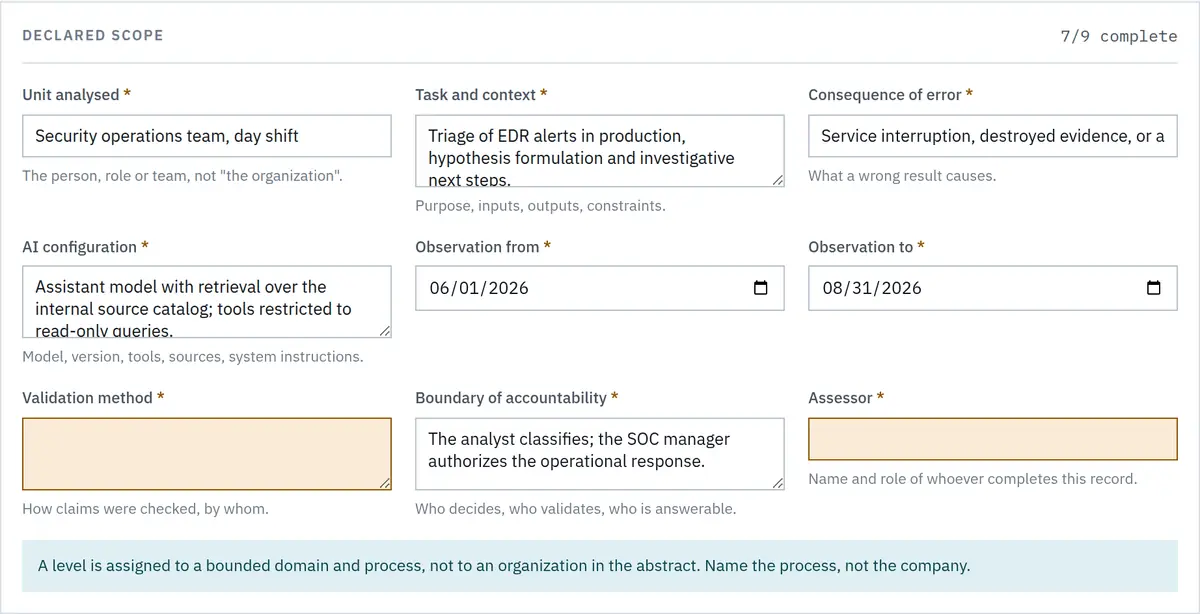
The whitepaper imposes a minimum reporting convention: any claim about HumanAI or OrgAI must identify the unit analysed, the task, the context, the AI configuration, the observation period, the validation method and the limit of responsibility. The instrument turns that into an operating condition.
Figure 5. Missing fields are highlighted. The counter shows 7 of 9 completed.Figure 6. The banner states how many fields are missing and that results remain provisional.
For as long as something is missing, export stays blocked and results are marked provisional. The modules keep calculating, so you can work, but you cannot produce a record that claims more than you know.
Figure 7. The complete record: the copy button becomes active.
The record also carries an identifier of its own. If you keep it when reassessing the same unit six months later, the two records form a comparable series instead of being two unrelated assessments.
Module 00: classification, before measurement
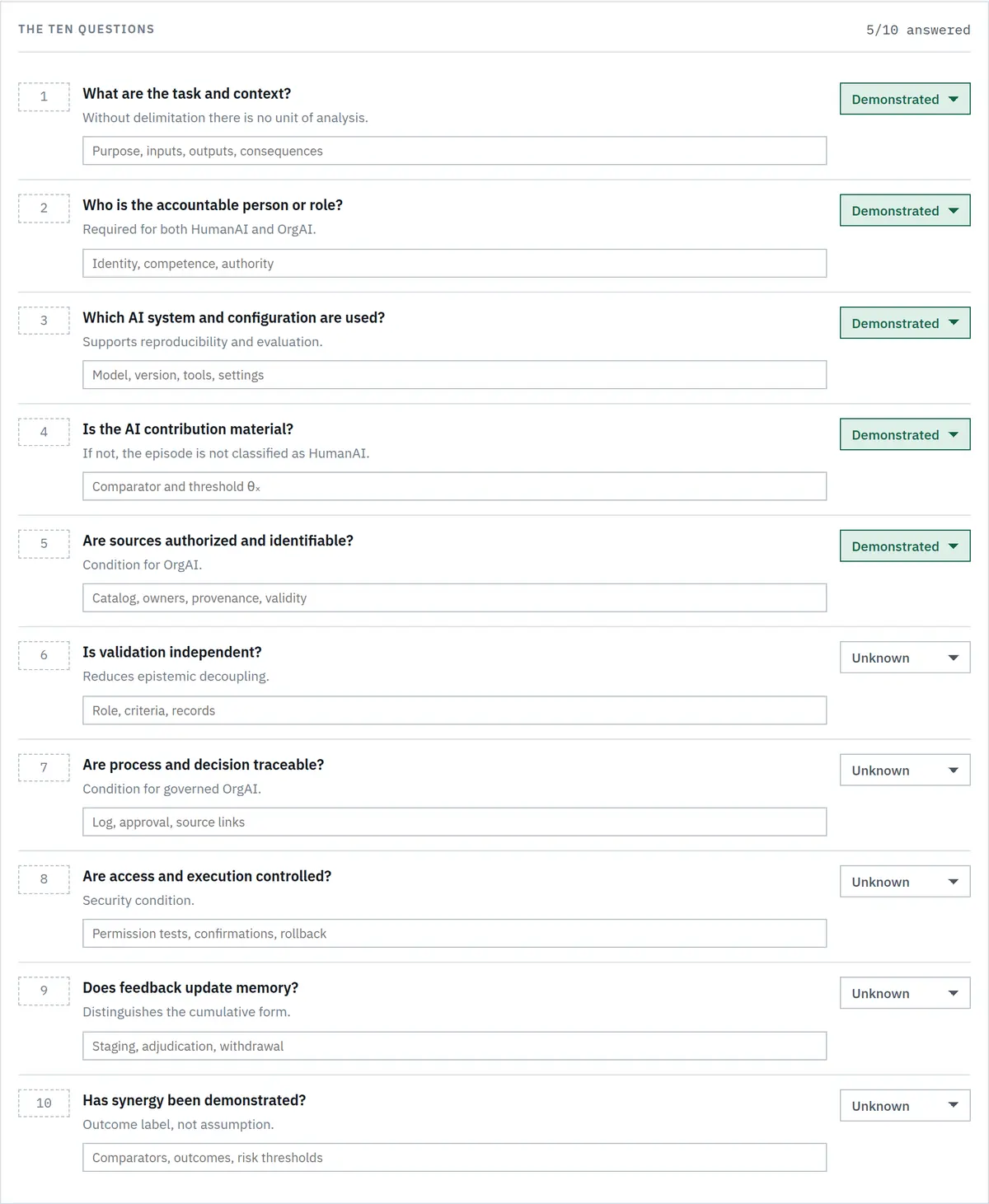
The first question is not “how much” but “what are we assessing”. The ten questions of the membership test establish whether the situation is a HumanAI case and whether it meets the conditions for OrgAI.
Figure 8. The ten questions. Each has a state and a field for the expected evidence.
Each question has three possible states, demonstrated, not satisfied and unknown, and a field in which you write the evidence, with a suggested example in place of the text (“catalogue, owners, provenance, validity”). The unknown state never counts as demonstrated.
One question alone stops the record: if you declare that the AI contribution is not material, the case is not HumanAI for that episode and the measurement modules no longer apply. Beneath the questions sits the list of cases the whitepaper excludes: an ignored suggestion, an automation with no AI component, several licences used independently.
Module 01: the gap between access and validation
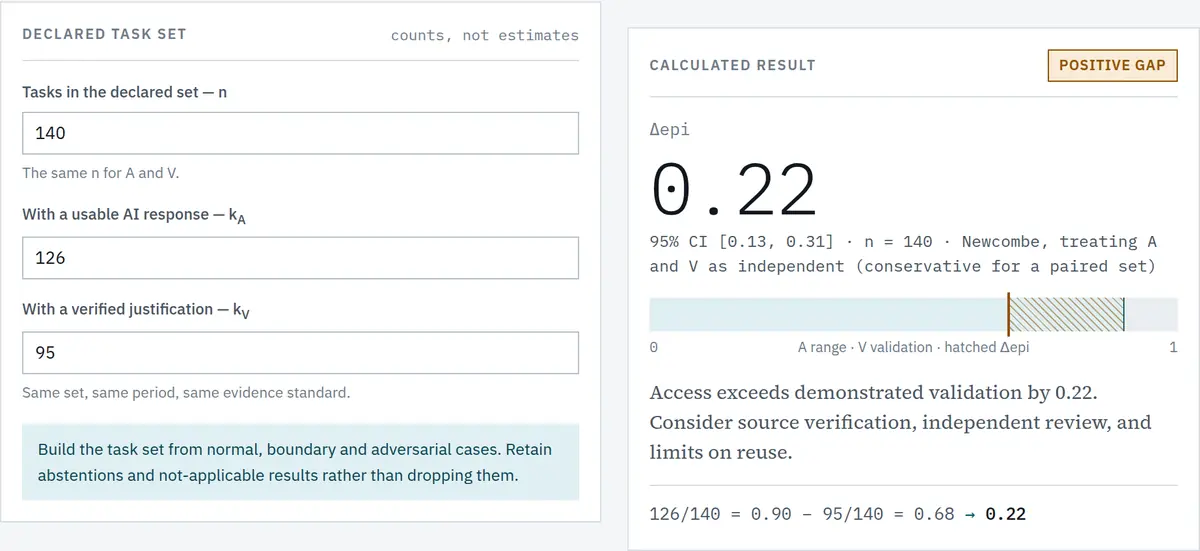
This is where the central idea of the framework sits. You enter three numbers: how many tasks are in the declared set, for how many AI produced a usable answer, and for how many the accountable person could produce a verified justification.
Figure 9. Module 01 at 140 tasks: 126 with a usable answer, 95 with a verified justification.
You enter counts, not estimated percentages. The reason is disciplinary: “about 90%” cannot be verified, “126 out of 140” can. And only counts allow the confidence of the result to be computed.
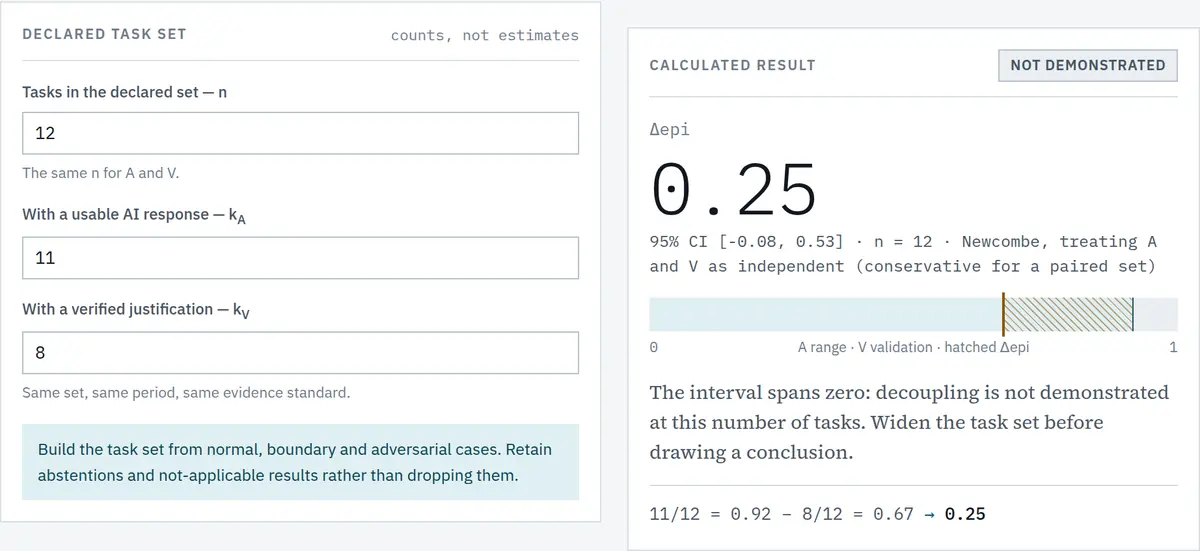
Compare the two screenshots. In the first, 0.22 over 140 tasks, with an interval of [0.13 – 0.31], gap demonstrated. In the second, a larger gap, 0.25, but over 12 tasks:
Figure 10. The same module at 12 tasks: the interval crosses zero, the verdict becomes “not demonstrated”.
The interval is [-0.08 – 0.53], so it includes zero, and the verdict becomes “Not demonstrated”, not demonstrated at this task volume. A larger gap, poorly measured, supports less than a smaller one measured well. The instrument does not hide that difference behind the same two-decimal number.
The verdict is “not demonstrated”, not “no gap”. The distinction matters: absence of evidence is not evidence of absence, and the instrument’s wording respects that.
Below the result, a positive gap does not end with a number: the module displays the seven mitigation measures from the whitepaper as a selectable list, and what you tick there feeds the next module.
Module 02: what happens to an error in the flow
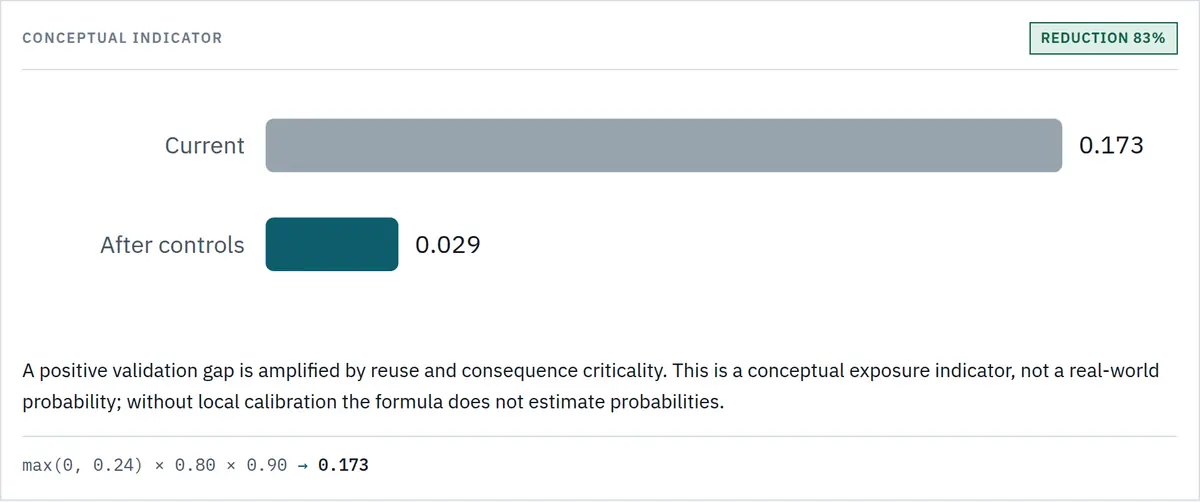
A gap in an isolated process is a local problem. In a process where the result is reused, it is amplified. The module models that amplification with two factors, the reuse rate and the criticality of the consequence, and computes two states: now, and after the controls you declare.
Figure 11. Current exposure and the target after controls, on the same scale.
The comparison is the argument, not the value on its own. The instrument shows the reduction as a percentage and flags separately the case in which the target would reduce exposure by cutting access rather than raising validation. Both lower the number, but they are entirely different decisions.
Module 03: the organisational architecture, with evidence
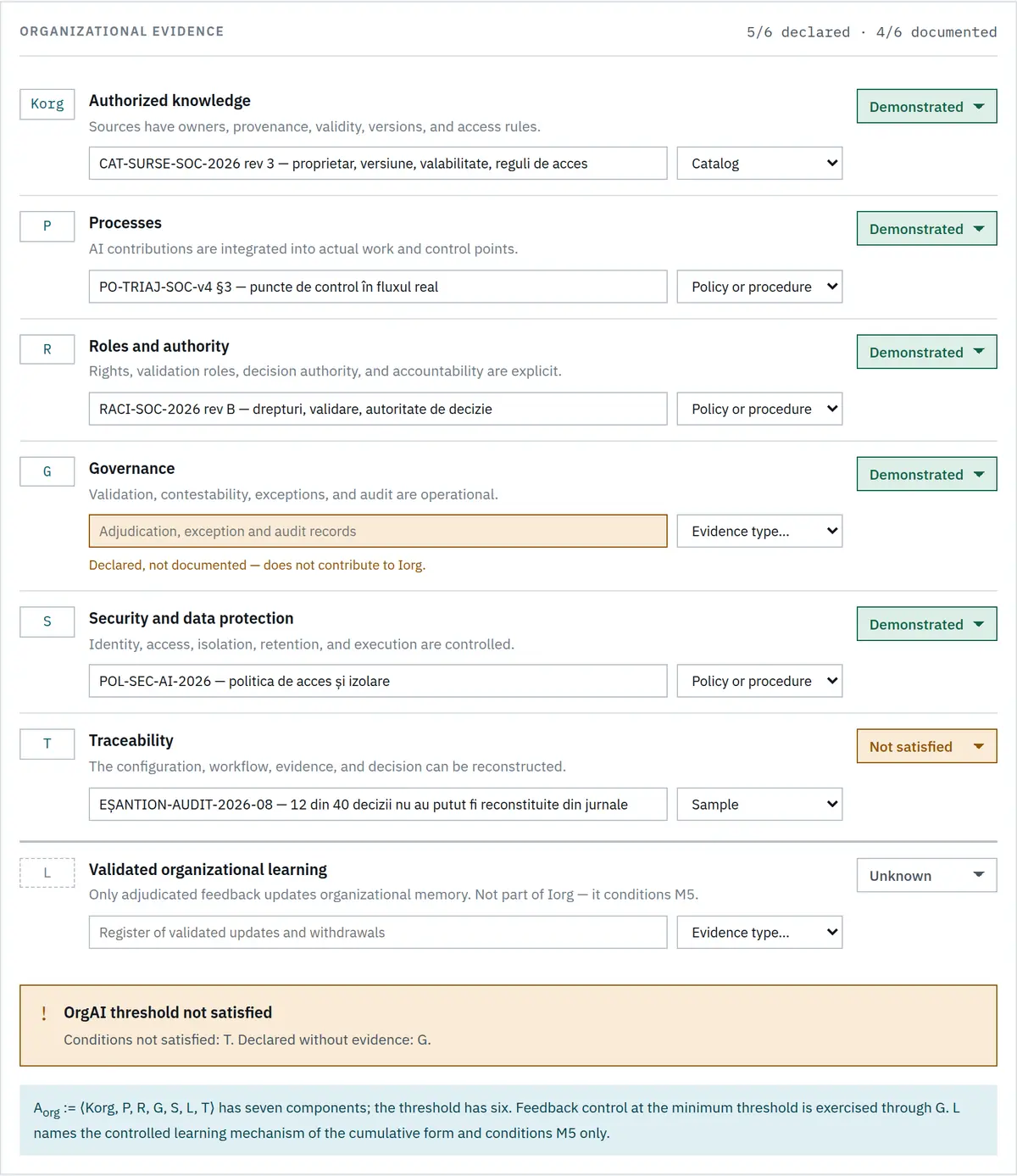
Six constitutive conditions: authorised knowledge, processes, roles and authority, governance, security, traceability. All six, otherwise the threshold is not demonstrated.
Figure 12. One criterion: the condition description, the evidence field, the evidence type and the state.
Each criterion has three fields instead of a checkbox: the state, an evidence reference and its type. The rule that changes the nature of the instrument is simple: a criterion marked “demonstrated” without an evidence reference appears as declared, undocumented, and the field is highlighted. It does not count towards the threshold.
The counter becomes a pair: “5/6 declared · 4/6 documented”. The second number is the one that counts, and the difference between them shows exactly the distance between what an organisation believes about itself and what it can show.
Below the six, separated by a line, sits the seventh component, validated learning. It is part of the architecture but not of the minimum threshold: it conditions the M5 level only. The distinction belongs to the framework, and the instrument shows it rather than hiding it.
Module 04: the profile, not the score
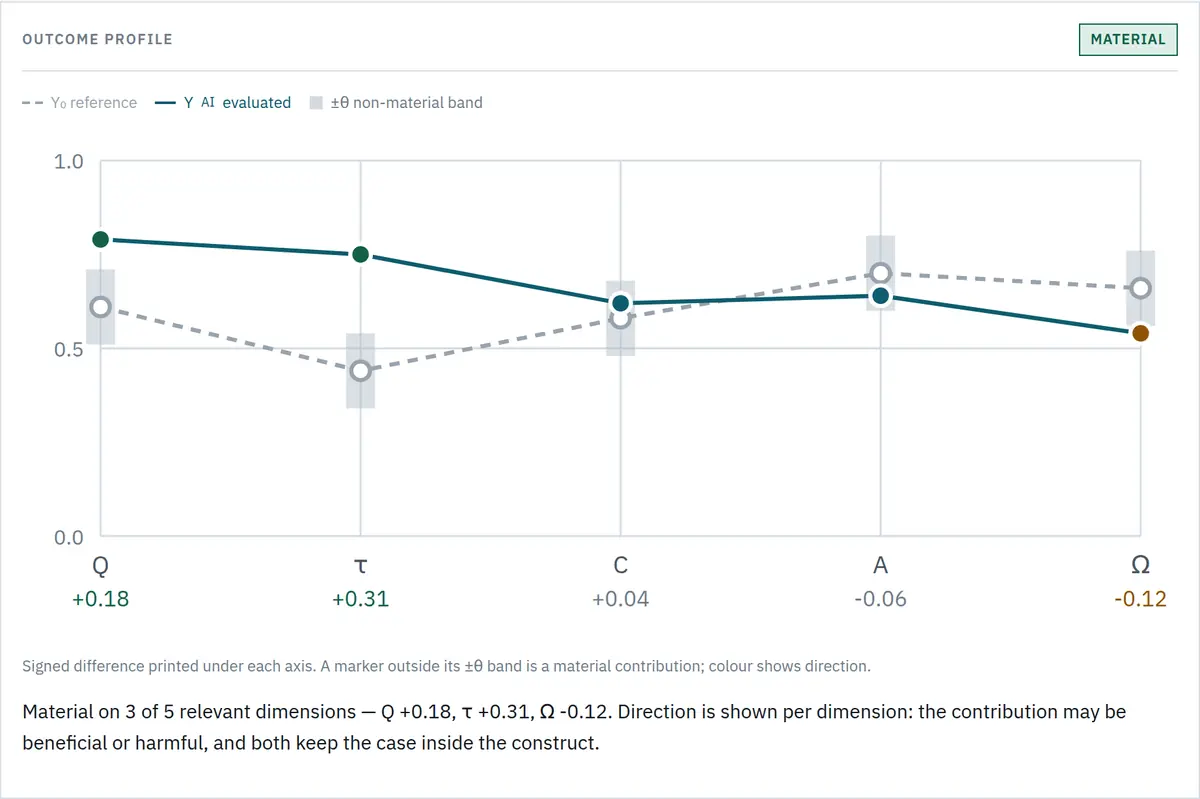
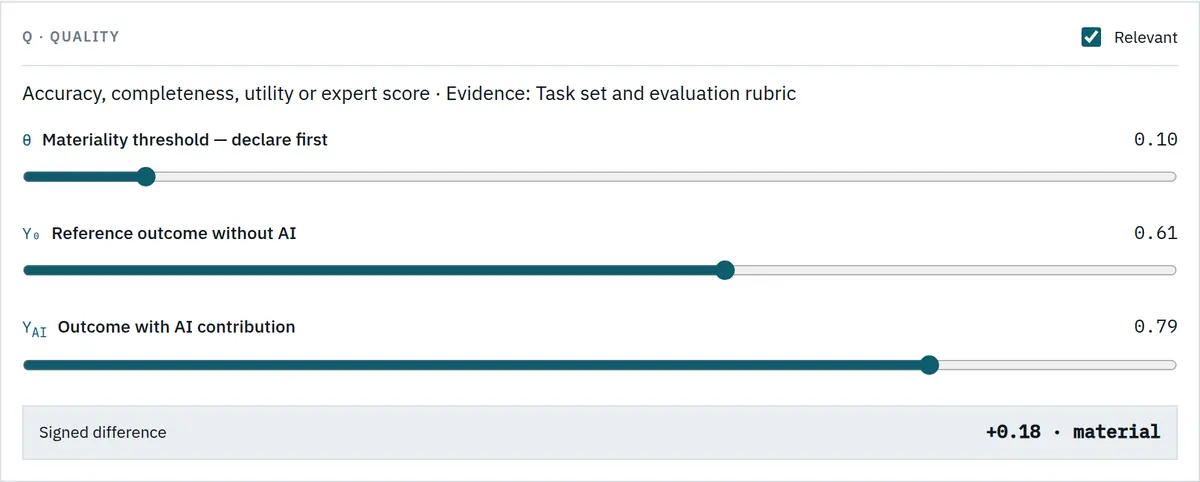
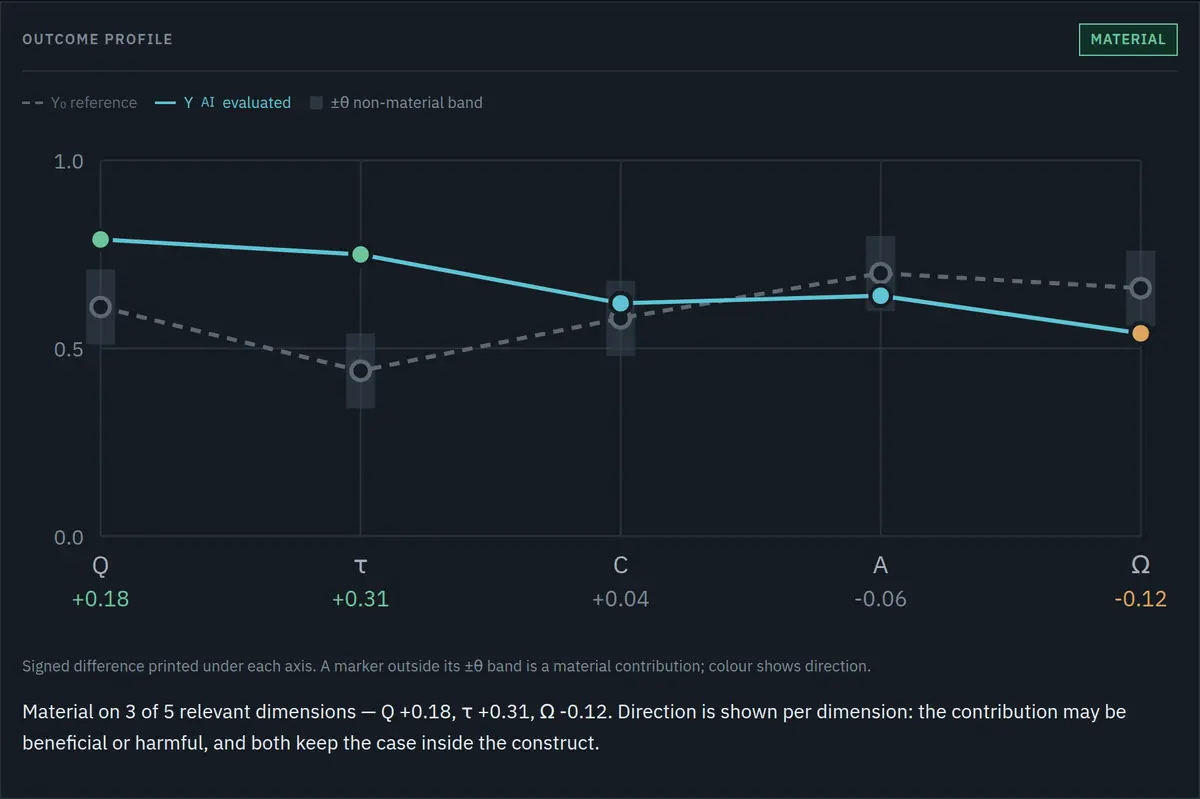
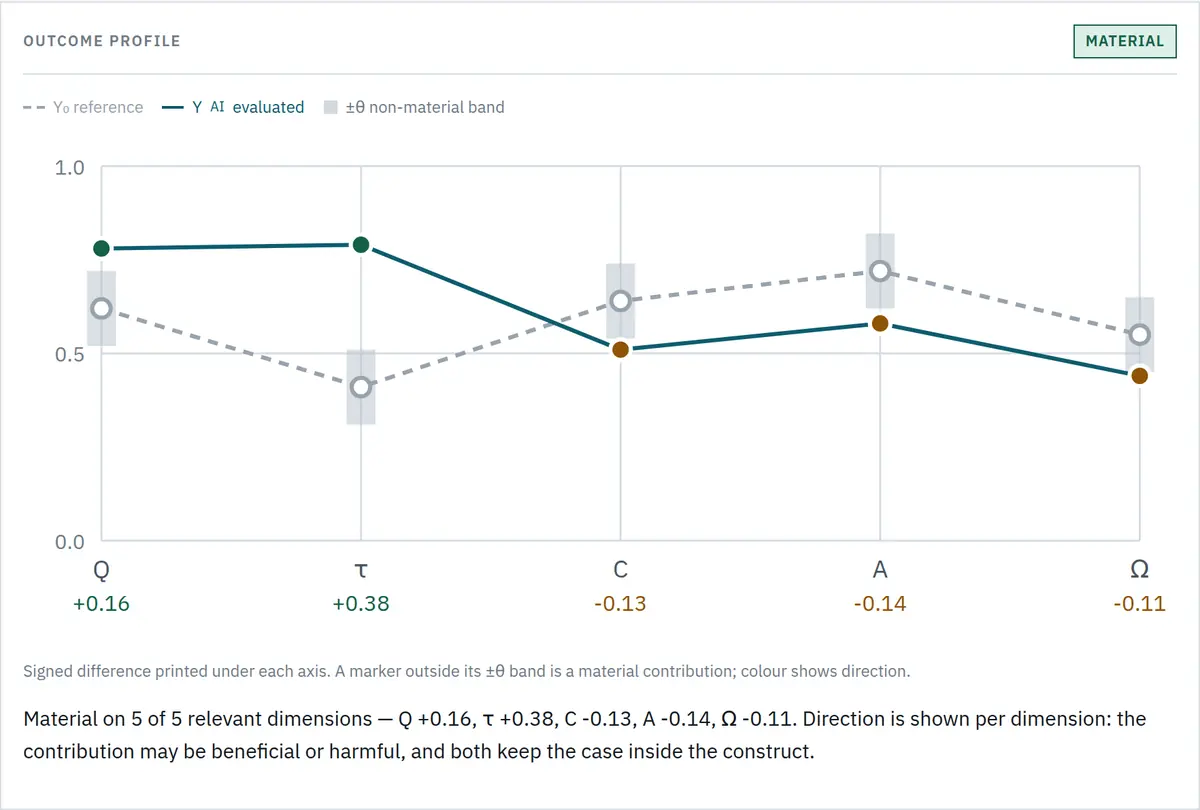
The AI contribution is assessed across seven dimensions at once: quality, time, error, calibration, autonomy, learning and risk exposure. It is material if it exceeds the declared threshold on at least one relevant dimension.
Figure 13. The profile. The dotted line is the baseline without AI, the solid line the assessed configuration, the grey band the threshold.
The chart shows what a single score would hide: in the illustrative example, quality and time improve, but autonomy and risk exposure worsen. The verdict is not compressed into a figure, it reads “material on 3 of 5 relevant dimensions”, with the difference and the direction for each.
Data is entered through one card per dimension:
Figure 14. The card for one dimension. The threshold is declared first, before the results.
The order of the fields is not accidental: the threshold appears before the two results, because the whitepaper requires it to be declared before the assessment, otherwise classification becomes opportunistic. If you change it after entering the results, the instrument records that in the record.
Figure 15. A dimension not marked relevant collapses to its title: it stays visible, but empty.
A dimension that cannot be measured credibly is not filled with zero and not reported as “n/a”. It is left out of the decision, and the card collapses.
Module 05: synergy, with declared thresholds
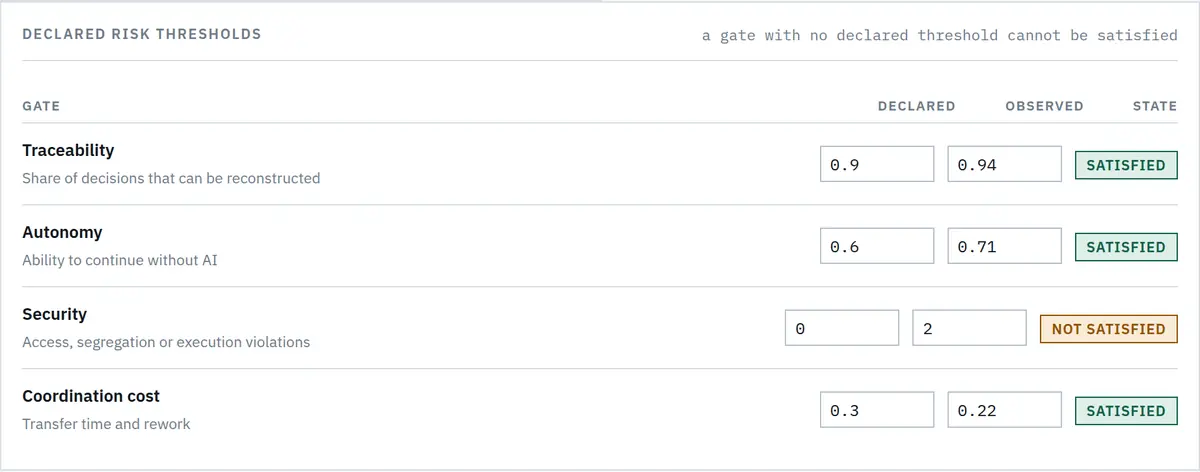
Synergy is not assumed and is not a maturity level. It is demonstrated: the configuration must exceed every relevant comparator on the same task, and every declared risk threshold must be satisfied.
Figure 16. The four risk gates. Each has a declared threshold and an observed value.
The gates are not checkboxes. Each requires a declared threshold and an observed value, and a gate without a declared threshold stays “undeclared” and blocks synergy just as a failed one does. You cannot demonstrate compliance with a threshold you never set.
The result names the comparator that binds the conclusion explicitly: “margin +0.06 over Human + AI (0.76)”. An anonymous margin would hide the decisive information: beating a person working alone and beating the best existing process are very different claims. The instrument also flags a weak comparator set.
Module 06: maturity, per domain
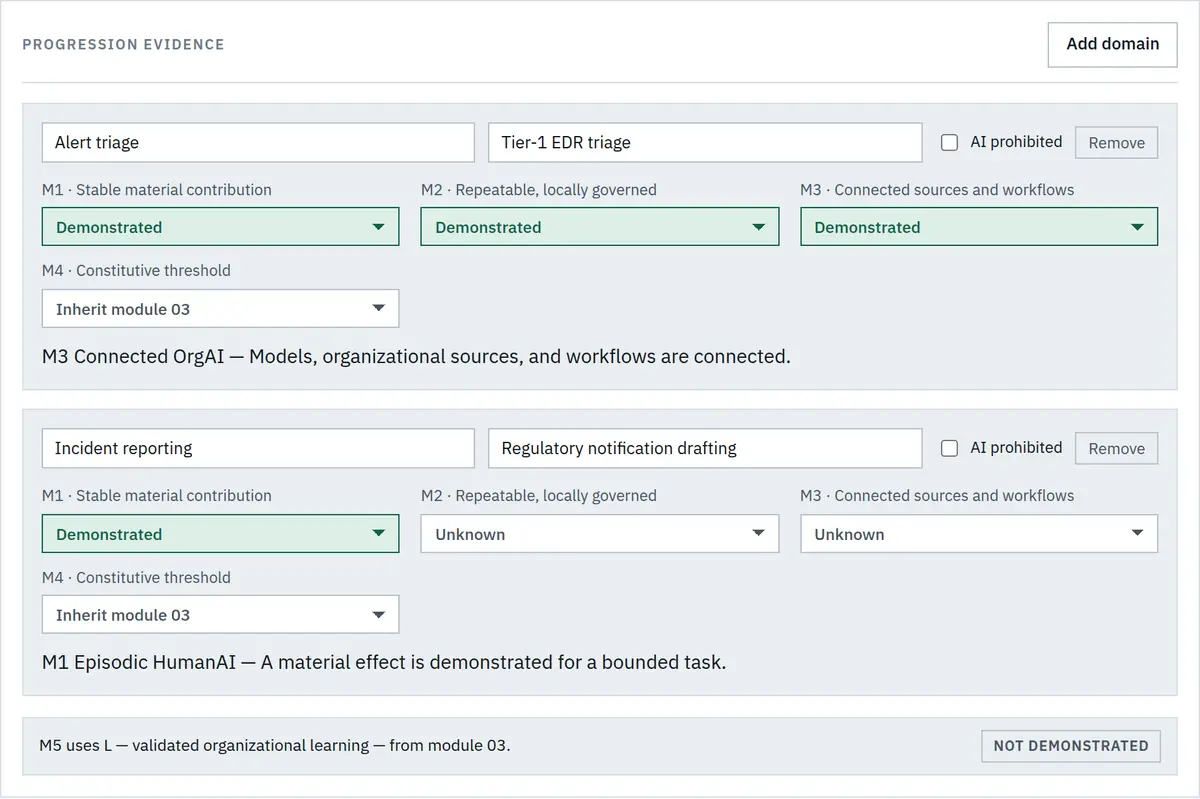
A level is assigned to a bounded domain and a process, not to an organisation. The whitepaper is explicit: the same company can be at M1 in one domain, M4 in another, and prohibit AI in a third.
Figure 17. Each domain has a name, a process, progression states and an “AI prohibited” option.
You add as many domains as you need. Each gets its own progression states and can inherit the threshold from module 03 or override it locally. A domain in which AI is prohibited is recorded as such and appears without a level, not as M0, because a governance decision is not a maturity shortfall.
Above it, a compact matrix shows every domain at once. Below it, the M0 to M5 levels with the minimum evidence and the limit of each: for M3, “connectivity does not demonstrate governance”; for M4, “learning may remain manual”; for M5, “adaptation does not demonstrate synergy”.
Module 07: what the architecture produces
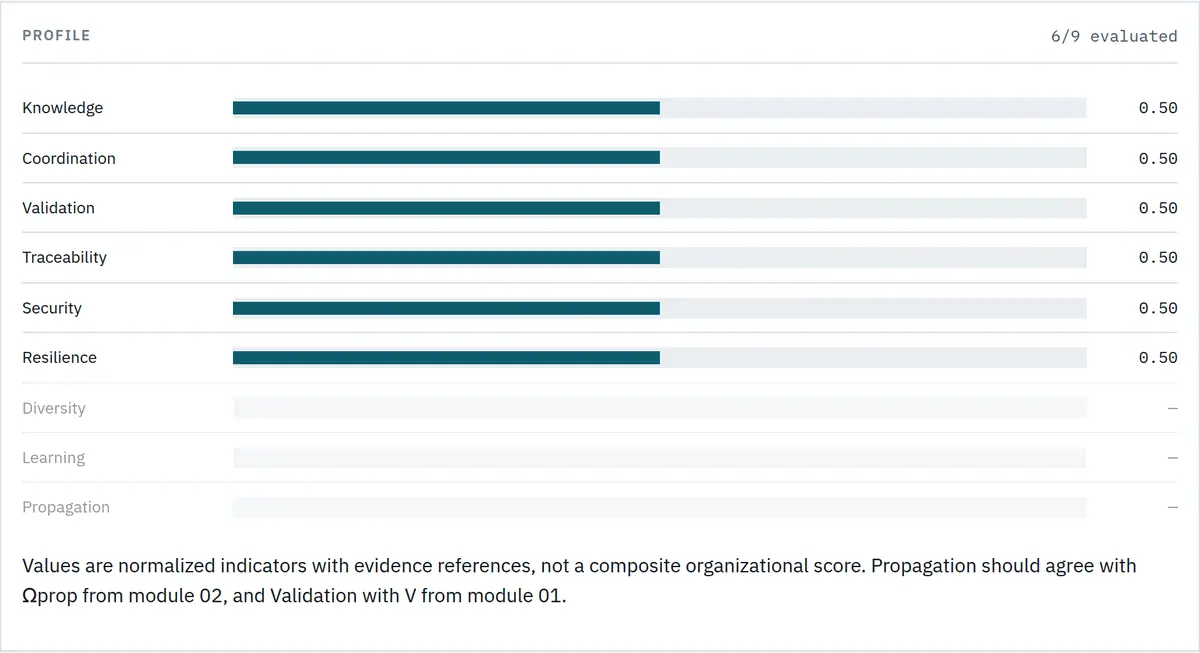
The threshold says the architecture exists. This module says what it produces: nine dimensions of organisational assessment, each with its value and its evidence.
Figure 18. The organisational profile. Dimensions not marked relevant stay dimmed.
Two dimensions correlate with other modules, propagation with the exposure indicator from module 02, validation with V from module 01, and a large gap between them is itself a finding: it points to verification that is formal only.
The diagnostic
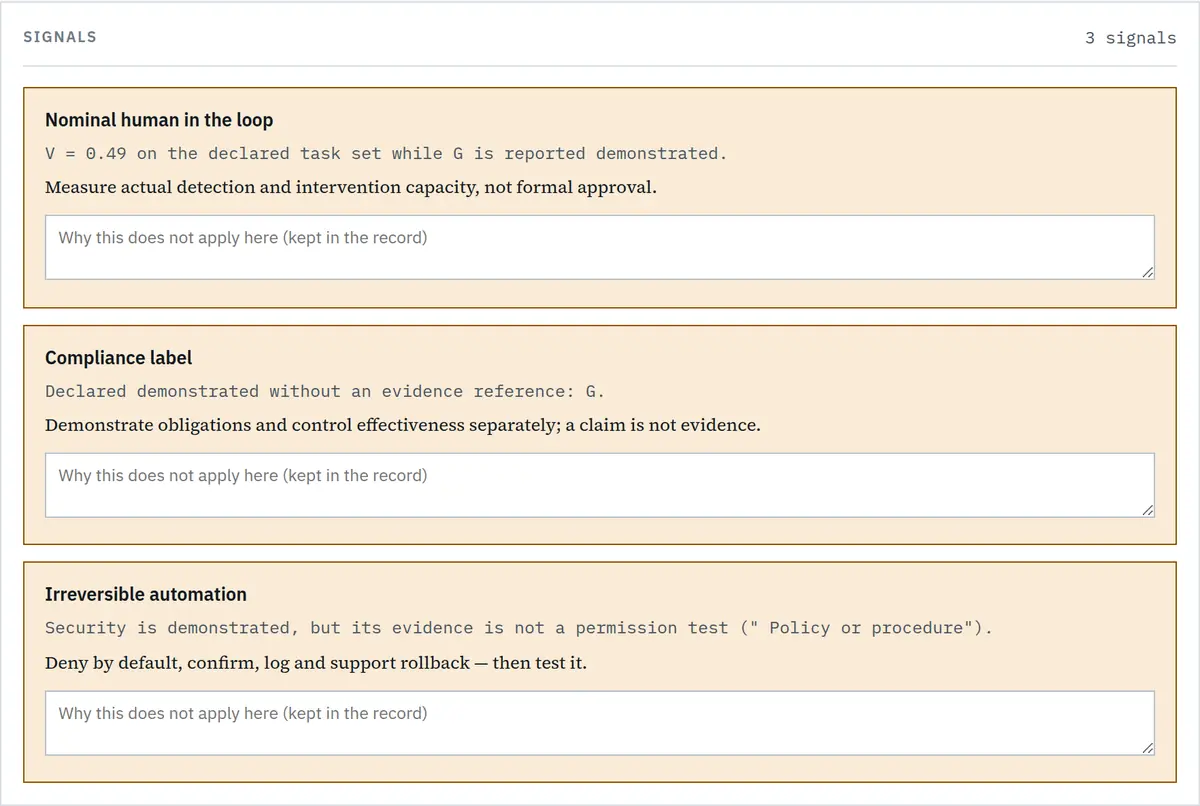
Across every module runs a detector that reads the configuration as a whole and looks for contradictions between what was declared in one place and what was measured in another.
Figure 19. The state with no flags. The wording avoids suggesting that an absence of signals means everything is fine.
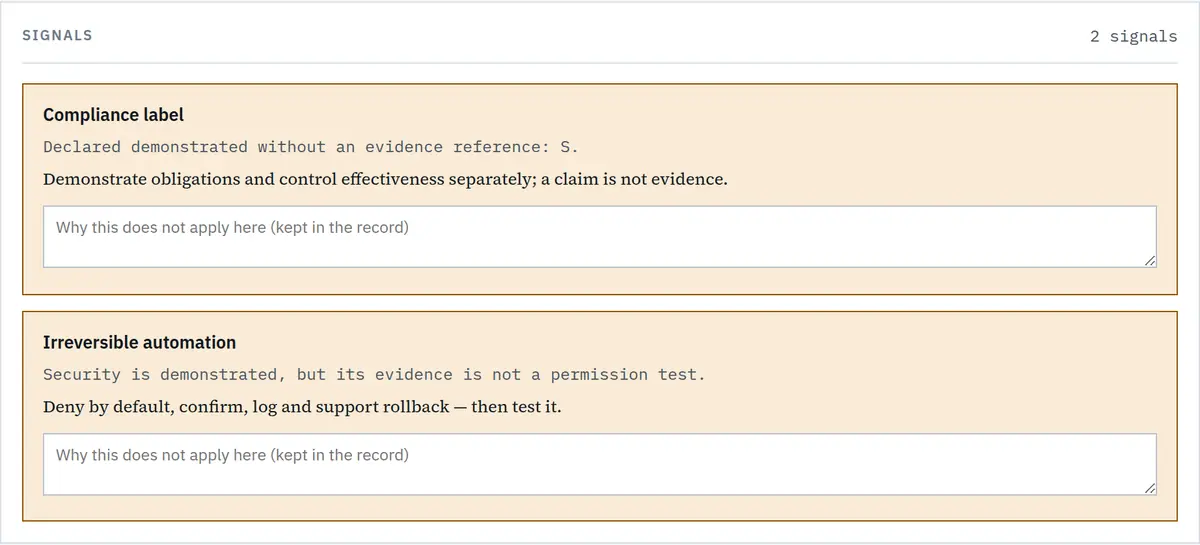
Eight patterns from the whitepaper plus two internal consistency checks. When a flag is raised, it shows what triggered it, with the concrete values from the record, and the correction the framework prescribes. It can be annotated, and the annotation enters the record.
Flags do not change any result and do not add up into a risk indicator: that would reintroduce exactly the anti-pattern the instrument avoids in module 04.
What comes out of the instrument
The record
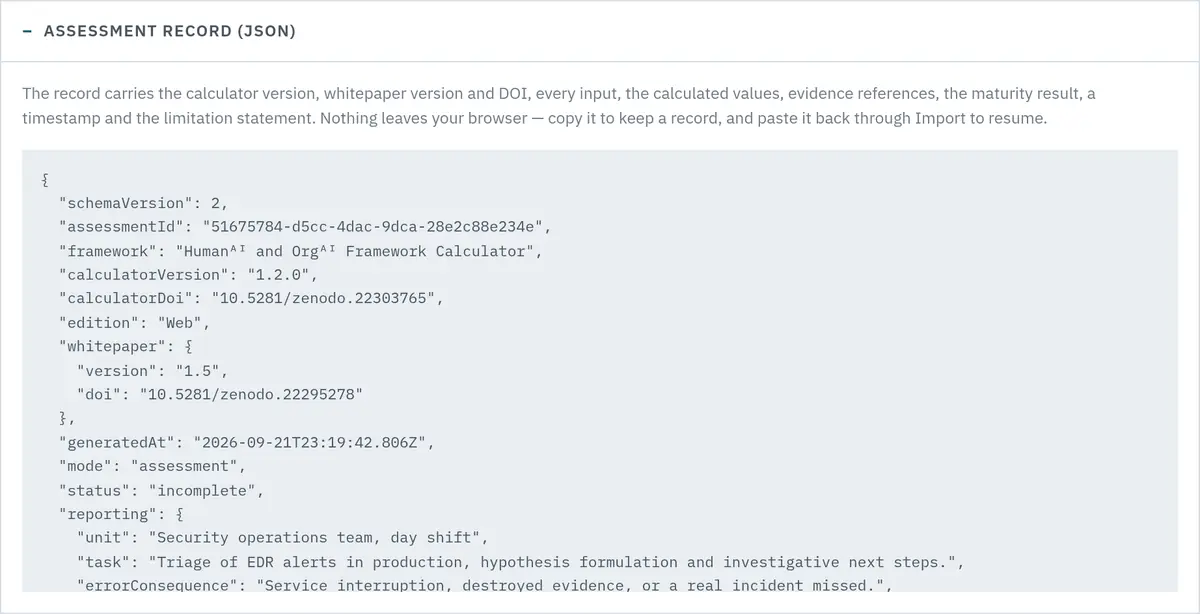
Figure 20. The record, visible in the page and copyable to the clipboard.
It contains the version of the instrument and of the whitepaper with their DOIs, every input, the computed values, the evidence references, the flags with their annotations, the record identifier, the generation timestamp and the limitation statement. It is copied to the clipboard rather than downloaded, because a page-initiated download does not work in every hosting context, and a button that does nothing is worse than no button.
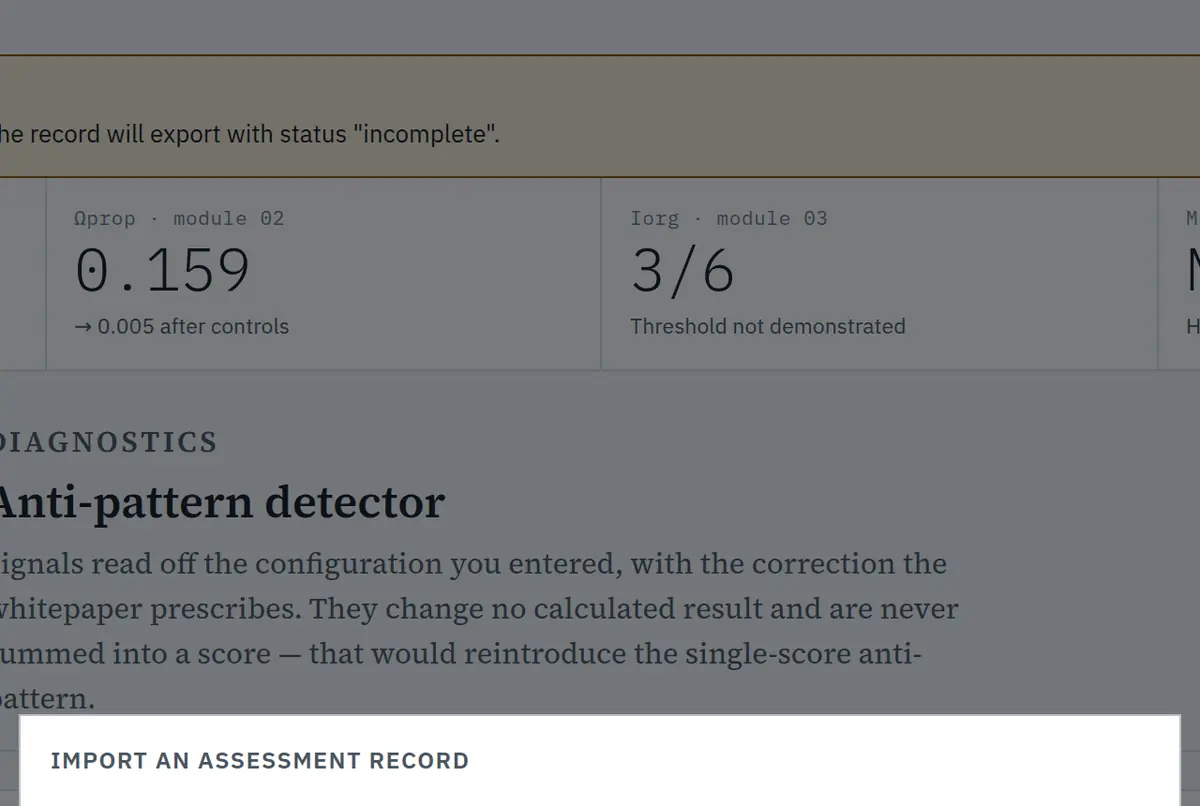
Import
Figure 21. Import accepts a pasted record. Records from v1.0.0 and v1.1.0 are migrated.
A record can be reloaded. That makes periodic reassessment possible: you reopen the same record six months later, change the period, recount, and compare. Records from earlier versions are migrated, with an explicit note of what could not be recovered.
The printed record
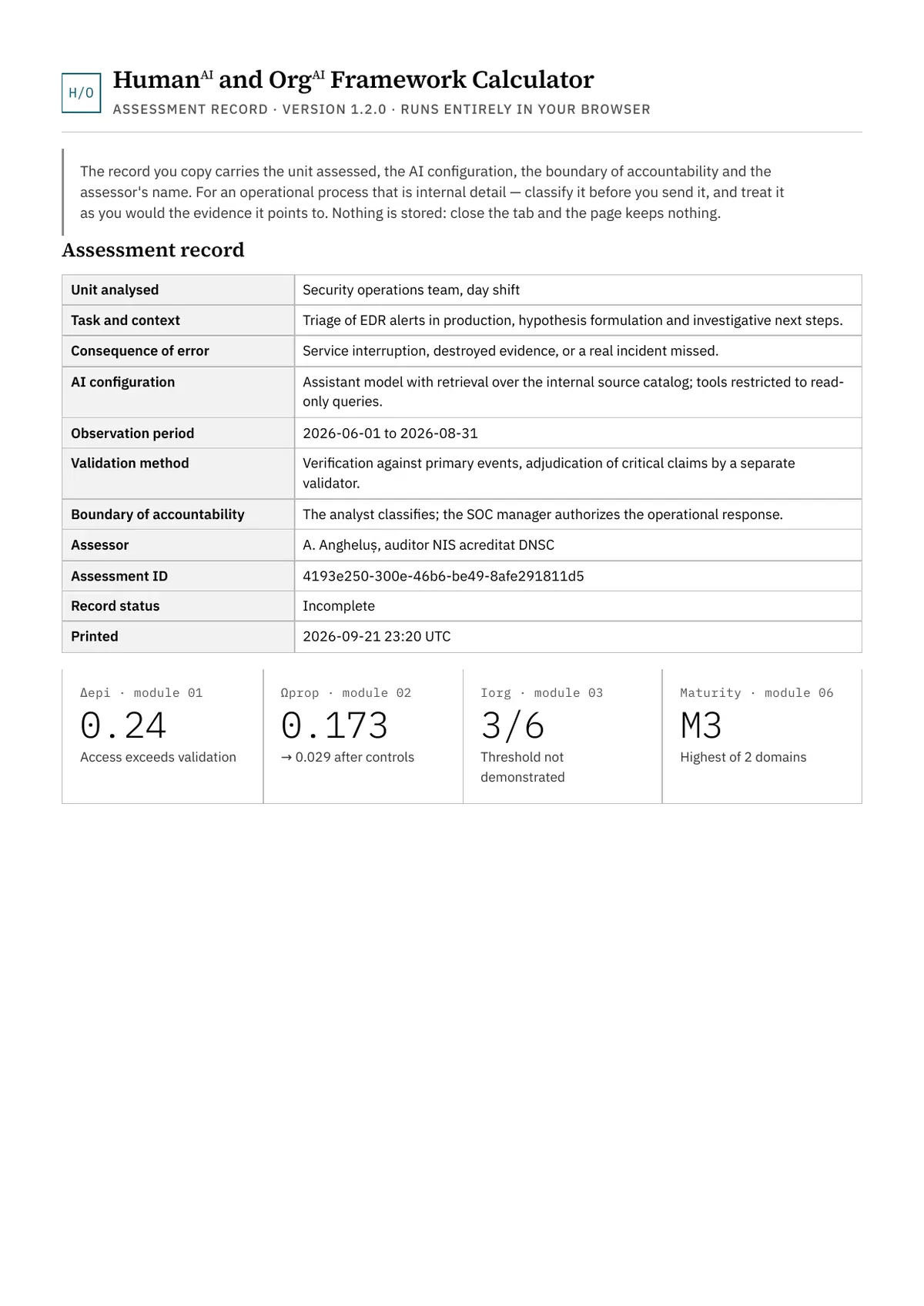
Figure 22. The first page of the printed record: the header with the minimum reporting convention.
Printing produces the document an auditor or a client receives: a header with the nine fields of the record, the identifier, the state and the date, then each module with its values rendered as text rather than as a form. Roughly 17 pages for a complete record. The JSON record is not printed, so the document is not duplicated.
Properties
Property
State
Installation
None. One HTML file opened in any modern browser
Network requests
None. Fonts are embedded; it works on an isolated network
Browser persistence
None. No localStorage, no cookies
Account, database, analytics
None exist
Security policy
Restrictive CSP in the self-hosted variant, with connect-src “none”
Themes
Light, dark and the system theme
Verification
29 automated tests that extract the logic from the delivered file
The last two deserve a look. The instrument follows the system theme with no setting:
Figure 23. The same module in the dark theme.
And the tests do not hold a copy of the formulas: they extract them from the shipped file, between two markers in the code, so they cannot drift from it. A passing run is a statement about the file in your hand, not about a laboratory version.
Limits
Results are interpretive. They do not constitute empirical validation, certification, legal advice or a compliance determination.
The instrument verifies nothing: every value remains a claim by the assessor until it is tied to the evidence it points to.
The propagation indicator is conceptual; without local calibration it does not estimate real probabilities.
Thresholds are declared by the user, according to domain and risk. The instrument does not calibrate them.
The “unknown” state never counts as demonstrated, at any step.
The instrument cannot be the sole basis of a consequential decision.
The last two remain permanently visible in the interface, not only in the documentation.
Citation and licence
The framework: Angheluș, A. (2026). HumanAI and OrgAI: A Relational Framework for AI-Mediated Human and Organizational Capacity, v1.5. Zenodo. DOI 10.5281/zenodo.22295278
The instrument: Angheluș, A. (2026). HumanAI and OrgAI Framework Calculator, v1.2.0. Zenodo. DOI 10.5281/zenodo.22884721
What does the guided tour of the calculator cover?
It walks screen by screen through the eight modules of the HumanAI and OrgAI Framework Calculator, plus the diagnostic, with 23 real screenshots: what you see, what you enter and what you get at each step.
What is the difference between exploration mode and assessment mode?
In exploration mode you can move values freely to see how the relationships behave; evidence references are not required, results are marked illustrative and export is disabled. In assessment mode the record becomes mandatory, and export unlocks only when it is complete.
Why are counts entered instead of percentages?
Because “about 90 per cent” cannot be verified, while “126 out of 140” can. Only counts allow the confidence interval that shows whether the gap is demonstrated at the assessed task volume.
What happens if a condition is marked demonstrated without evidence?
It appears as declared, undocumented, the field is highlighted, and it does not count towards the constitutive threshold. The counter shows two numbers, declared and documented, and the difference between them shows the distance between what an organisation believes about itself and what it can show.
What does the instrument produce at the end?
Three things from the same record: the on-screen assessment, a printed record of about 17 pages with the minimum reporting convention in its header, and a JSON record containing the inputs, computed values, evidence references and the limitation statement.
Can an assessment be repeated six months later?
Yes. The JSON record is copied, archived and re-imported, including from earlier versions. If you keep the record identifier, the two assessments form a comparable series instead of two unrelated ones.
A group of employees using the same AI model does not constitute organizational capacity. The difference between the two is not one of scale but of architecture, and the HumanAI / OrgAI framework makes it visible, measurable and auditable.
Alexandru Angheluș · September 2026 · Based on “HumanAI and OrgAI: A Relational Framework for AI-Mediated Human and Organizational Capacity”, version 1.5, DOI 10.5281/zenodo.22295278, licensed CC BY-ND 4.0.
The question a licence count cannot answer
AI adoption is usually reported through product names, licence counts or automation volumes. Those figures show that the technology is available. They do not show which capacity has been created, where knowledge resides, how results are validated, or who holds authority.
The same interface may support a competent professional, induce uncalibrated dependence, or propagate an error throughout an organization. The central confusion is between individual AI use and organizational capacity. Without authorized sources, roles, validation, traceability, security and controlled memory, the result is aggregated use rather than governed capacity.
For a security or compliance officer the consequence is immediate and practical: in a supervisory enquiry, an audit or a risk assessment, a licence count is not an answer. It does not say which sources produced the conclusion, who verified it, who is accountable for it, or how it can be reconstructed.
Two constructs, two units of analysis
HumanAI
HumanAI denotes a situated person–AI–task–context configuration in which an AI system materially changes a person’s performance, judgment, learning or vulnerability, while the human role and decision authority remain identifiable.
The contribution may be positive, neutral or negative. Overreliance, error or skill erosion do not remove a case from the category, they describe its outcome profile. The configuration is episodic when it concerns a bounded task, and becomes stable when repeated use changes the person’s practice, trust, competence, autonomy or validation behaviour.
OrgAI
OrgAI denotes the organizational socio-technical configuration in which HumanAI episodes, AI systems, authorized institutional knowledge, roles, workflows, validation, traceability, security and control jointly mobilize a distributed capacity that cannot be attributed to a single user or model.
OrgAI is not a product, a model, an agent or a document repository. It is a property of the organizational configuration.
Reading rule: HumanAI and OrgAI describe configurations, not outcomes. A configuration may produce good, poor or unsafe results. Category membership and outcome quality are separate judgments.
Excluded cases
An ignored AI suggestion with no material effect does not constitute HumanAI in that episode.
A deterministic automation without an AI component is not included merely because it is complex.
Multiple independently used AI licences do not constitute OrgAI.
A chatbot connected to unverified documents does not demonstrate authorized organizational knowledge.
A system-only decision without identifiable authority and accountability does not satisfy the governed framework.
The membership test
Classification is not established by declaration but through seven questions applied to a bounded configuration.
Test
HumanAI
OrgAI
Identifiable unit
person, system, task and context
organizational process, actors, systems and knowledge
AI contribution
materially changes execution or judgment
is integrated into institutional capacity
Authority
human role and decision can be attributed
roles, approvals and escalations are defined
Knowledge
relevant sources can be delimited
sources are authorized, versioned and owned
Validation
the person can verify in proportion to risk
validation is independent and institutionalized
Traceability
the episode can be reconstructed
the workflow and decision can be audited
Learning
effects on the person can be tracked
validated feedback updates memory in a controlled manner
Table 1. Membership and boundary criteria.
The constitutive threshold: why OrgAI is not the sum of episodes
The relationship between the two levels is one of conditional integration. Individual episodes provide local contributions. Organizational architecture selects, authorizes, coordinates, validates and retains only those contributions that can become part of institutional capacity.
OrgAI ≠ Σ HumanAIᵢ
Iorg = 1[Korg ∧ P ∧ R ∧ G ∧ S ∧ T]
The Iorg indicator expresses the minimum conceptual threshold: Korg is authorized institutional knowledge, P are processes and control points, R are roles and accountability, G is governance with validation, contestability and audit, S is security and data protection, and T is configuration and decision traceability.
If any of these components is missing, the configuration may represent connected or aggregated AI use, but it does not demonstrate governed OrgAI. Controlled learning is required for the cumulative form, not for the minimum threshold.
The transformation mechanism
An actor performs a task within a delimited HumanAI configuration.
The output is accompanied by sources, configuration, interventions and confidence level.
A competent role validates or rejects the contribution in proportion to risk.
The decision is attributed and integrated into a controlled organizational process.
Accepted conclusions may update memory only through a separate adjudication workflow.
Outcomes and errors are monitored, and access or rules can be withdrawn or corrected.
Epistemic decoupling: the risk that appears in no control catalogue
Epistemic decoupling is the gap between the range of claims, interpretations or options that AI makes accessible and the demonstrated capacity of the accountable actor to validate them.
Δepi(T; X, t) = A(T; X, t) − V(T; X, t)
Across a declared task set T, A is the proportion of tasks for which the system provides a usable response, and V is the proportion for which the accountable actor can produce a verified justification. The difference is calculated within the same domain and ranges from −1 to 1. A high positive value shows that access has outpaced validation.
The distinction matters for governance because it separates three questions that practice routinely conflates: what the system can generate or retrieve, what the competent actor can validate, and who is authorized to decide or execute. Access to a claim does not automatically produce justified knowledge, and technical validation does not automatically confer decision authority.
Observable signals
Responses are accepted faster than their sources can be checked.
Citations, explanations or calculations cannot be reproduced independently.
The same output is reused across processes without reassessing context.
Reported confidence rises while error-detection rates decline.
Organizational memory is updated with unadjudicated outputs.
Authority is formally assigned to a person, but practical constraints make contestation impossible.
Mitigation measures
Limit the domain and state the unknowns.
Cite and verify primary sources.
Require independent validation for high-impact outputs.
Separate generation from approval and execution.
Test trust calibration and error detection.
Control reuse and memory updates.
Preserve the right to contest, to stop, and to return to the unassisted process.
Propagation: how a local error becomes systemic risk
Ωprop = max(0, Δepi) × ρ × κ
ρ is the rate at which an output is reused or diffused, and κ is consequence criticality. Without local calibration the formula does not estimate real-world probabilities. Its role is different: it makes visible why a small error, reused frequently in a critical process, may become a major organizational risk, and why reducing decoupling has a multiplicative rather than linear effect.
Five use scenarios
7.1. Analysis and research
An analyst uses AI to identify themes, synthesize documents and formulate hypotheses. The configuration is HumanAI when the intervention materially changes the scope or speed of analysis. The corpus must be bounded, citations verified, inferences labelled as such, and the analyst’s decision retained.
The configuration becomes part of OrgAI only when sources, rights, methodology, validation and reuse are integrated into an institutional process. The dominant risk is that a plausible but unverified synthesis becomes organizational fact.
7.2. Creation, communication and marketing
AI can expand the space of concepts, audiences and creative variants. Each creator–model–brief relationship is HumanAI. OrgAI requires authorized data, asset rights, approval criteria, versions, performance evaluation and controlled feedback. Abundance does not demonstrate relevance and may produce narrative convergence or homogenized expression.
7.3. Cybersecurity
A security operations analyst uses AI to correlate alerts, formulate hypotheses and propose investigative steps. HumanAI describes the analyst–model–telemetry episode. OrgAI emerges when identities, data classification, chain of custody, sources, approval roles, logging and response procedures are integrated.
Automatic execution of proposed commands, contamination of memory with unverified indicators, or exposure of investigative data are cases in which speed has overtaken control. Destructive operations require explicit confirmation, separation of duties and rollback capability.
7.4. Compliance and evidence evaluation
AI can map requirements to policies, controls and evidence. At HumanAI level the assessor receives suggestions and syntheses. At OrgAI level the organization manages control owners, periods, versions, exceptions, approvals and evidence lineage. The existence of a document does not establish control operation, and an automated score does not demonstrate compliance.
7.5. Organizational memory and strategic decision-making
An organization connects AI to policies, projects, lessons learned and prior decisions. Retrieval is useful only if sources have status, version, owner and scope. The cumulative form emerges when validated conclusions update memory without self-confirmation and obsolete information can be withdrawn. Strategic decisions remain attributable to authorized roles.
Scenario
HumanAI unit
Threshold for OrgAI
Dominant risk
Analysis
analyst, model, corpus, question
institutional sources and validation
unverified citations and conclusions
Creation
creator, model, brief, audience
rights, approval, controlled feedback
convergence and unauthorized use
Security
analyst, telemetry, hypothesis
chain of custody, roles, audit
incorrect execution and contamination
Compliance
assessor, requirement, evidence
owners, periods, adjudication
apparent compliance
Memory
user, question, internal sources
validity and validated learning
propagation of obsolete information
Table 2. Scenario summary.
Demonstrative case study: assessing an incident
Status: this case is hypothetical and explanatory. The values are illustrative, not empirical findings, and do not represent the performance of any real product or organization.
An organization must assess a potential cyber incident. Inputs include alerts, logs, internal procedures, threat intelligence and prior reports. A wrong conclusion may interrupt services, destroy evidence, or cause a real incident to be missed.
The HumanAI episode
The analyst asks the model for a timeline, hypotheses and validation steps. AI reduces triage time and expands the hypothesis space, so its contribution is material. The analyst verifies events in primary sources, marks inferred claims, and retains authority over classification. The configuration remains HumanAI even when some suggestions are rejected.
Aggregated use that is not OrgAI
Several analysts use the same model independently and copy its answers into tickets. There is no source catalogue, configuration version, adjudication role or rule for updating memory. This is aggregated AI use. Activity volume does not compensate for missing architecture.
The governed OrgAI configuration
Sources are classified, owned and filtered before retrieval according to analyst identity.
Retrieved content is treated as untrusted data and cannot introduce executable instructions.
The model produces hypotheses linked to primary events and states missing data.
A separate validator adjudicates critical claims, while the decision-maker approves the operational response.
Commands are denied by default and require confirmation, logging and target-domain validation.
Only adjudicated conclusions can update case memory; rejected indicators are withdrawn and remain auditable.
Illustrative decoupling calculation
Initial: A = 0.92; V = 0.68; Δepi = 0.24
After controls: A = 0.92; V = 0.88; Δepi = 0.04
Access has not been reduced, but validation capacity has increased through primary sources, adjudication and traceability. If the reuse rate ρ is 0.80 and criticality κ is 0.90, the conceptual propagation indicator falls from 0.173 to 0.029. The values only explain the relationship among variables.
The practical observation for a security officer is that the fix was not to restrict access to the tool, the usual reflex, but to raise validation capacity. Restricting access would have lowered A, and with it the utility, without addressing the underlying problem.
Maturity: six states, none of them mandatory
The maturity model describes observable states of integration, not an obligation to reach the highest level. For some tasks, a managed HumanAI configuration is more appropriate than the cumulative form. A level is assigned to a bounded domain and process, not to an organization in the abstract.
Level
Description
Minimum evidence
Boundary
M0 Exploratory
occasional use without stable practice
inventory of uses or experiment
does not demonstrate stable HumanAI
M1 Episodic HumanAI
AI materially changes bounded tasks
artifacts and task comparator
the effect is not institutionalized
M2 Managed HumanAI
practice is repeatable and governed locally
guidance, measurement, validation, owner
more users do not imply OrgAI
M3 Connected OrgAI
models access organizational sources and workflows
The status of synergy: “Synergistic OrgAI” is an outcome label, not an M6 level. It applies only to a configuration and task for which comparators and risk thresholds have been evaluated explicitly.
An organization may operate at M1 in one domain, at M4 in another, and prohibit AI use in a third. Applying a single level to a whole organization is itself an assessment error.
Governance: roles, incompatible shortcuts and threats
Governance is not a separate chapter of the framework but the element that constitutes the category. Removing authority, validation or traceability does not weaken an OrgAI configuration, it moves it out of the category.
Role
Primary responsibility
Incompatible shortcut
Process owner
defines purpose, scope and acceptance criteria
delegating purpose to the vendor or model
Knowledge owner
authorizes sources, validity and withdrawal
treating every accessible document as authoritative
User or operator
performs the task and records interventions
copying output without review
Validator
tests claims against criteria and evidence
validating one’s own high-impact output without controls
Decision-maker
accepts consequences and authorizes action
assigning responsibility to AI
Security and privacy
controls access, isolation, retention and incidents
relying solely on vendor terms
Audit or oversight
tests reconstruction, exceptions and effectiveness
treating policy existence as operating evidence
Table 4. Roles and separation of duties.
Threat
Mechanism
Minimum controls
Prompt injection
retrieved content manipulates model behaviour
separate instructions from data, sanitize, constrain tools, test adversarially
identity propagation, least privilege, target checks, deny by default
Hallucinated authority
plausible output is treated as an approved decision
source verification, status labels, validator and decision-maker
Memory contamination
unverified feedback becomes institutional truth
staging, adjudication, provenance, rollback and withdrawal
Automation bias
human review becomes formal rather than effective
error-detection tests, time allocation, independent evidence, contestability
Common-mode failure
one defect propagates across downstream uses
diverse sources, dependency mapping, monitoring and kill switch
Table 5. Threat model and minimum controls.
What the framework does not demonstrate
Much of the framework’s practical value lies in what it refuses to confirm.
Anti-pattern
Why it is incorrect
Correction
AI as authority
output is treated as the decision
retain a decision-maker, validation and contestability
Nominal human in the loop
a person approves without time, competence or evidence access
measure actual detection and intervention capacity
OrgAI by licence count
account numbers are confused with integration
evaluate sources, roles, workflows and controls
Memory without adjudication
all feedback becomes institutional truth
separate raw feedback from approved updates
Single score
trade-offs and risks are hidden
report dimensional profiles and thresholds
Convenient comparator
gain is measured against a weak baseline
include the best realistically available process
Irreversible automation
a suggestion triggers action without control
deny by default, confirm, log and support rollback
Compliance label
the concept is treated as legal or audit evidence
demonstrate obligations and control effectiveness separately
Table 6. Anti-patterns and corrections.
Six explicit clarifications follow: HumanAI does not mean that a person becomes AI or that a system acquires human status; HumanAI is not synonymous with success; OrgAI is not the name of a model or a commercial package; access to an internal corpus does not demonstrate provenance, validation or authority; automation does not transfer accountability to AI; and using the term OrgAI does not make an organization mature, safe or compliant.
The regulatory boundary
The framework supports analysis and control design but does not establish legal compliance. Systems with material effects on rights, safety, employment, finance, health, security or public services require domain-specific legal assessment, data protection analysis, competent human oversight, contestability, separation of duties and evidence preservation. The HumanAI or OrgAI labels do not replace applicable obligations.
From framework to implementation
Stage
Activity
Exit criterion
1. Delimitation
select process, tasks and consequences
approved scope, owner and exclusions
2. Baseline
measure the process without the new configuration
comparator, thresholds and task set
3. Controlled HumanAI
pilot with users, rules and validation
documented material contribution and risk profile
4. Knowledge
catalogue and authorize sources
owners, validity, access and withdrawal
5. OrgAI threshold
integrate roles, workflow, audit and security
Iorg test satisfied with evidence
6. Operational pilot
test normal, boundary, adversarial and unavailable states
approved acceptance criteria and residual risk
7. Controlled learning
introduce adjudicated feedback and withdrawal
updatable, auditable, reversible memory
8. Monitoring
track profiles, changes and incidents
periodic review and stop conditions
Table 7. Implementation pathway.
Stop conditions
Implementation must stop or return to the previous state when data exposure, loss of decision attribution, degradation in error detection, unauthorized access, memory contamination, inability to reproduce critical results, or an unvalidated configuration change occurs.
The computational companion
The HumanAI and OrgAI Framework Calculator is the separately versioned digital companion to the framework. It operationalizes six relationships defined in the whitepaper: epistemic decoupling, propagation exposure, the constitutive OrgAI threshold, material contribution, synergy and maturity classification.
It should be used only after defining the unit of analysis, task, context, observation period, comparator, materiality threshold and evidence standard. Every organizational condition must be supported by evidence, and an unknown state never counts as demonstrated. The local release calculates in the browser and can export a JSON assessment for reproducibility and audit. Exported values remain user-entered claims until linked to evidence; results are not empirical validation, certification, legal advice or a compliance determination.
The HumanAI and OrgAI calculator, layer by layer: the inputs, the evidence rule, modules 01–07, the ten-predicate detector and the export gate, with formulas and four computations you can run on the page.
The HumanAI and OrgAI framework, layer by layer: the foundations, the individual configuration, the membership test, the Iorg threshold, epistemic decoupling, maturity M0–M5 and governance, with four computations you can run directly on the page.
The framework’s value does not depend on who first used the HumanAI notation, nor on the absolute absence of a similar expression for OrgAI. It depends on definitional clarity, on the separation of constructs from outcomes, on the relational model, and on the ability to make accountability, validation, authority and risk visible.
In practice, the decisive question is not whether an organization uses AI. It is whether the organization can demonstrate which capacity it has created, in which domain, from which sources, through which roles, with what validation, and within which limits. HumanAI makes the person’s configuration visible. OrgAI makes visible the institutional architecture that can turn it into controlled collective capacity.
For security and compliance professionals the operational consequence is that assessment applies to a bounded configuration rather than to a model, and that validation, not access, remains the central problem between the availability of technology and real capacity.
Source
Angheluș, A. (2026). HumanAI and OrgAI: A Relational Framework for AI-Mediated Human and Organizational Capacity. Version 1.5, 4 September 2026. DOI: 10.5281/zenodo.22295278. Licensed under Creative Commons Attribution-NoDerivatives 4.0 International.
For governing the AI tools an organisation actually uses, CysAI provides a catalogue of AI agents with risk profiles and tracking of artificial intelligence regulation.
Frequently asked questions
What is HumanAI?
HumanAI, also written HumanAI, denotes a situated person, AI system, task and context configuration in which the system materially changes a person’s performance, judgement, learning or vulnerability, while the human role and decision authority remain identifiable.
What is OrgAI?
OrgAI denotes the organisational socio-technical configuration in which HumanAI episodes, AI systems, authorised institutional knowledge, roles, workflows, validation, traceability and security together mobilise a distributed capacity. It is not a product, a model or a document store, but a property of the configuration.
What is the difference between HumanAI and OrgAI?
It is not a difference of scale but of architecture. OrgAI is not the sum of HumanAI episodes. The constitutive threshold requires, cumulatively, authorised knowledge, processes, roles and accountability, governance with validation and contestability, security and traceability. If any is missing, the result is aggregated use, not governed capacity.
What is epistemic decoupling?
It is the distance between the range of claims AI makes accessible and the demonstrated capacity of the accountable actor to validate them, computed as the difference between the proportion of tasks with a usable answer and the proportion with a verified justification, over the same declared task set.
Do multiple AI licences amount to OrgAI?
No. Multiple licences used independently are aggregated use. A seat count demonstrates no authorised sources, roles, independent validation, traceability or controlled memory, and under audit a licence count answers no supervisory question.
What maturity levels does the framework define?
Six observable states, from M0 explorer to M5 cumulative OrgAI. A level is assigned to a bounded domain and process, not to an organisation in the abstract. The same organisation can be at M1 in one domain, M4 in another, and prohibit AI in a third.
Does the framework establish legal compliance?
No. It supports analysis and control design, but does not replace domain-specific legal assessment, data protection analysis, competent human oversight or separation of duties. The HumanAI and OrgAI labels do not replace applicable obligations.
Version 1.2.0 of the HumanAI and OrgAI Framework Calculator is publicly available at no cost. It is a single HTML file that runs entirely in the browser: no installation, no account, and no network request of any kind. It opens unchanged on a machine with no internet connection.
The instrument accompanies the whitepaper “HumanAI and OrgAI: A Relational Framework for AI-Mediated Human and Organizational Capacity”, and turns the relationships defined there into an assessment record you complete for a concrete situation: one process, one team, one observation period.
In short
What it is: the digital instrument that operationalises the HumanAI and OrgAI framework, also written HumanAI and OrgAI.
How it runs: one HTML file, in the browser, no installation, no account, no network requests, no localStorage.
What it contains: eight modules and an anti-pattern detector.
What it produces: an on-screen assessment, a printed record of about 17 pages, and a re-importable JSON record.
Licence: code under MIT, conceptual framework under CC BY-ND 4.0.
Every organisation that has introduced AI into a process eventually faces the same question: does it work?
The usual answer rests on two observations: people are visibly faster, and nobody has complained. Both may be true. Neither answers the question.
The difficulty is that “does it work” conflates things that must be measured separately: what the system can produce, what the accountable person can validate, who is authorised to decide, and what happens to a wrong conclusion once it enters the workflow. The framework separates them. The calculator makes them computable.
The central distinction is epistemic decoupling: the gap between the range of answers AI makes accessible and the demonstrated capacity of the accountable actor to validate them. When access grows faster than validation, an organisation produces claims it cannot support, and then reuses them.
What it looks like
Figure 1. The opening screen. The calculator starts from a worked example rather than an empty form.
Eight modules and a diagnostic panel. The modules are a sequence rather than a menu: module 02 consumes the result of 01, module 06 depends on 03, and the classification worksheet can stop everything else if the situation does not belong to the construct.
Module
What it establishes
00. Classification
Whether the situation is a HumanAI case, through a ten-question membership test
01. Epistemic decoupling
The gap between access and validation, with a confidence interval
02. Propagation exposure
How an unvalidated error is amplified by reuse, now and after declared controls
03. OrgAI threshold
Whether the six constitutive conditions are demonstrated or merely declared
04. Contribution profile
On which dimensions AI changes the outcome, in which direction, and what is lost
05. Synergy test
Whether the result exceeds the relevant comparators with declared risk thresholds satisfied
06. Maturity
The M0 to M5 level for each bounded domain separately
07. OrgAI profile
What the organisational architecture actually produces, not merely that it exists
What changed since version 1.0.0
This release began from an uncomfortable finding: in four places, the calculator contradicted its own whitepaper.
Material contribution was evaluated on a single dimension chosen from a dropdown, although the whitepaper defines a seven-dimension profile and explicitly forbids compressing it into a score.
The exported record carried none of the seven fields of the minimum reporting convention, and so was not citable under the framework’s own rule.
Access and validation were entered as slider values, although they are proportions over a declared task set, which manufactured an apparent precision with nothing behind it.
Validated organisational learning appeared disconnected from the architecture it belongs to.
All four are fixed. No formula defined in the whitepaper was altered, and the six assertions of the original test suite pass unchanged.
On top of the repairs, the missing constructs were added: the classification worksheet, an evidence reference for every organisational condition, exposure compared before and after controls, the nine-dimension organisational profile, maturity assessed per domain, the anti-pattern detector, and a JSON schema that can be re-imported.
Three things worth seeing
A profile, not a score
Figure 2. The contribution profile across five relevant dimensions. The data come from a demonstrative case.
In the example above, AI made security alert triage significantly faster and moderately better. At the same time, confidence calibration, analyst autonomy and risk exposure all worsened, each beyond the declared threshold.
A composite score would have summed the five values and reported a gain. The result would have been technically correct and entirely misleading: part of the speed came from reduced validation. The instrument refuses to produce that number, not because of a technical constraint, but because the whitepaper forbids compressing the profile, and a single score hides exactly the trade-off that matters.
A number without a volume says nothing
Figure 3. A gap of 0.22 measured over 140 tasks: interval [0.13 – 0.31], gap demonstrated.Figure 4. A larger gap, 0.25, but over 12 tasks: the interval crosses zero and the verdict becomes “not demonstrated”.
Access and validation are entered as counts, how many tasks out of how many, not as estimated percentages. The counts produce a confidence interval, and when that interval includes zero the instrument says “not demonstrated at this task volume”, not “no gap”.
A larger gap, poorly measured, supports less than a smaller one measured well. The instrument does not hide that difference behind the same two-decimal number.
A claim is not evidence
Figure 5. The constitutive threshold. A condition marked without an evidence reference is highlighted and does not count towards the threshold.
Each of the six organisational conditions requires an evidence reference and its type, not a checkbox. A condition marked “demonstrated” without a reference appears as declared, undocumented, and does not count towards the threshold. The counter becomes a pair, declared and documented, and the difference between the two numbers shows the distance between what an organisation believes about itself and what it can show.
Figure 6. The anti-pattern detector: each flag shows the values that triggered it and the correction prescribed by the framework.
Across all modules runs a detector that reads the configuration as a whole and looks for contradictions between what was declared in one place and what was measured in another. It is the only component that tells the assessor something they did not know on the way in.
Properties
Property
State
Installation
None. One HTML file opened in any modern browser
Network requests
None. Fonts are embedded; it works on an isolated network
Browser persistence
None. No localStorage, no cookies
Account, database, analytics
None exist
Security policy
Restrictive CSP in the self-hosted variant, with connect-src “none”
Verification
29 automated tests that extract the logic from the delivered file
The last line deserves an explanation. The tests do not hold a copy of the formulas: they extract them from the shipped file, between two markers in the code. A passing run is a statement about the file in your hand, not about a laboratory version.
Where to get it
The instrument is deposited on Zenodo with a citable DOI: 10.5281/zenodo.22884721, version 1.2.0. The record contains the source archive and the ready-to-use index.html. No unpacking is needed: the file opens directly in the browser.
Results are interpretive. They do not constitute empirical validation, certification, legal advice or a compliance determination.
The instrument verifies nothing: every value remains a claim by the assessor until it is tied to the evidence it points to.
The propagation indicator is conceptual; without local calibration it does not estimate real probabilities.
Thresholds are declared by the user, according to domain and risk.
The instrument cannot be the sole basis of a consequential decision.
The last two remain permanently visible in the interface, not only in the documentation.
Interactive guide
The HumanAI and OrgAI calculator, layer by layer: the inputs, the evidence rule, modules 01–07, the ten-predicate detector and the export gate, with formulas and four computations you can run on the page.
What is the HumanAI and OrgAI Framework Calculator?
It is the digital instrument that operationalises the relationships defined in the HumanAI and OrgAI whitepaper. You complete it for a bounded situation, one process, one team and one period, and it produces a reproducible assessment record with eight modules and an anti-pattern detector.
How do I get it, and why does it need no installation?
It is a single HTML file, deposited on Zenodo with DOI 10.5281/zenodo.22884721. It opens directly in any modern browser. It has no account, database or server and makes no network request, so it behaves identically on a machine with no internet connection.
Why does it not produce a single score?
Because the whitepaper forbids compressing the contribution profile into one figure. A composite score can hide speed obtained by reducing validation. The instrument reports a profile across dimensions, with the direction and size of each change.
What does the verdict “not demonstrated” mean in epistemic decoupling?
It means that, at the declared task volume, the confidence interval of the gap includes zero. It does not mean there is no gap, only that the available data do not support one. Absence of evidence is not evidence of absence.
What is the licence and how should it be cited?
The code is licensed under MIT, while the conceptual framework, the definitions and the interpretive text remain under CC BY-ND 4.0. When you rely on the definitions or the interpretation, cite both: the whitepaper, DOI 10.5281/zenodo.22295278, and the instrument, DOI 10.5281/zenodo.22884721.
Can the results be used as evidence of compliance?
No. Results are interpretive and do not constitute empirical validation, certification, legal advice or a compliance determination. The instrument verifies nothing: values remain claims by the assessor until they are tied to the evidence they point to.
The framework, the definitions, the variables, the formulas and the interpretive model were developed by Alexandru Angheluș, an independent and self-funded author. Artificial intelligence and automation tools were used selectively for software development, structural organisation, drafting and verification activities. Responsibility for the conceptual model and for the software remains entirely with the author.
We use cookies and similar technologies to store and access information on your device, for statistics and for the operation of this site. You can accept, decline, or choose by category. Declining may limit some features.
Functional
Always active
The technical storage or access is strictly necessary for the legitimate purpose of enabling the use of a specific service explicitly requested by the subscriber or user, or for the sole purpose of carrying out the transmission of a communication over an electronic communications network.
Preferences
The technical storage or access is necessary for the legitimate purpose of storing preferences that are not requested by the subscriber or user.
Statistics
The technical storage or access that is used exclusively for statistical purposes.The technical storage or access that is used exclusively for anonymous statistical purposes. Without a subpoena, voluntary compliance on the part of your Internet Service Provider, or additional records from a third party, information stored or retrieved for this purpose alone cannot usually be used to identify you.
Marketing
The technical storage or access is required to create user profiles to send advertising, or to track the user on a website or across several websites for similar marketing purposes.