Meet Jamie and the World of the Internet

Hey kids! Let’s talk about Jamie, who’s a lot like you. Jamie loves playing games, chatting with friends, and exploring the internet. But one day, Jamie got an email from someone he didn’t know, offering a free gift in exchange for some personal details. Hmm, what do you think Jamie should do? Should he share his information for a gift?

The Secret Code of Cybersecurity

Cybersecurity is like having a secret code that keeps your treasure chest of personal information safe. It’s all about protecting your details from people who might use them in the wrong way. Imagine your personal information is a treasure, and cybersecurity is the code that locks it up safely.

The Power of Passwords

Do you have a secret code, or a password, for your games or apps? How many of you use the same password for everything? It might be easy to remember, but it’s like having one key for every lock in your house. If someone finds that key, they can open everything! What if we make unique and strong passwords for each account? A strong password is like a strong castle – the more complex it is, the harder it is for hackers to break in.

Stranger Danger Online

Now, imagine you’re playing your favorite online game, and someone asks for your address to send you a game accessory. Is that safe? Just like in real life, not everyone online is friendly. Sharing personal details, like where you live or your school name, can be risky. It’s better to keep some things a secret on the internet.

Beware of Tricky Gifts and Prizes

Remember the email Jamie got? Offers for free gifts or prizes can be exciting, but they can also be tricks called phishing attempts. Hackers use these to get your personal information. When you get messages like these, should you click on links or download things? Nope! It’s best to ignore them and tell an adult you trust.

Be a Cybersecurity Superhero

Cybersecurity might sound complicated, but it’s really about making smart choices to keep your information safe. Just like you wouldn’t share a secret with a stranger, don’t share personal info online without thinking. Next time you’re entering a password, sharing details, or about to click a link, stop and think: is this safe? And if you’re not sure, always ask a grown-up you trust.

So, are you ready to be a cybersecurity superhero, guarding your personal info from the internet’s villains? Your smart actions can help keep the internet a fun and safe place for everyone! 🌐🔒🦸‍♀️🦸‍♂️

The Magical Digital Ocean

Hey there, young explorers! Do you know why your parents and teachers often remind you to be careful on the internet? It’s because the online world is like a vast, magical ocean. It’s full of wonders and fun, but just like a real ocean, it has some hidden dangers. Let’s dive into an exciting story about a little fish named Fin and learn how to safely navigate this digital ocean.

Fin’s Exciting Discovery

Meet Fin, a bright-eyed, curious fish who loved exploring. One day, while swimming through the ocean, Fin discovered a new, dazzling area. It was filled with colorful corals and friendly fishes, much like when you discover a new game or social media app on the internet. Fin was thrilled, but he remembered something important – he needed to explore this new place carefully and wisely.

Balancing Time

Fin enjoyed exploring this vibrant part of the ocean, but he knew he couldn’t stay there forever. He had other things to do – like going back to his cozy coral home, eating his favorite seaweed snacks, and resting. This is just like how you have schoolwork, playtime with friends, and bedtime. Fin’s adventure teaches us that it’s important to balance our time online with other important activities in our lives.

Celebrating Uniqueness

In this new, exciting part of the ocean, Fin met many different fishes. Some were bigger, some shone brighter, but Fin realized something special – he was unique in his own way, and that was awesome! Just like Fin, you should always remember that you are special and unique. Don’t compare yourself to others you see online. Everyone is different, and that’s what makes the world so interesting!

The Power of Kind Words

Fin learned to communicate with the other sea creatures respectfully. He knew that words, like water currents, could be gentle or strong. He chose to use gentle, kind words. This is called good online manners, or ‘online etiquette.’ It’s really important to remember to be kind and polite when you’re chatting, commenting, or playing games on the internet.

The Joy of Unplugging

Fin was a wise little fish. He knew that spending too much time in this new, enchanting part of the ocean could be overwhelming. So, he made a smart choice – to take breaks and spend time with his family and friends. Just like Fin, it’s good for us to unplug from the digital world now and then. Playing outside, reading books, or spending time with family helps us stay happy and healthy.

Safe and Happy Exploring

From Fin’s adventure, we learn some important lessons: set time limits for using the internet, celebrate our uniqueness, be kind online, and take breaks to enjoy the world around us. The internet is a fantastic place to learn and play, but we must explore it safely and happily, just like Fin did in his ocean.

So, kids, remember to swim safely in the digital ocean. Explore, learn, and have fun, but always be like Fin – smart, kind, and careful! 🌟🐠🌐🎮📚

Introduction: Navigating the Digital Landscape

In an era where digital technology permeates every aspect of our lives, the importance of cyber security has never been more pronounced. This article, designed as a companion piece to our informative video, delves into the critical need for cyber security education in our increasingly connected world. We aim to shed light on the alarming trends in cybercrime and emphasize how enhanced knowledge and awareness are pivotal in safeguarding our digital existence.

Understanding the Cyber Threat Landscape

Cybercrime statistics paint a daunting picture, signaling an urgent need for action. Daily, millions fall prey to a variety of cyber threats, ranging from identity theft to sophisticated financial scams. This section, echoing our video’s content, provides a detailed analysis of current cybercrime trends. It aims to offer readers a comprehensive understanding of the risks prevalent in the digital space, highlighting why no individual or entity is immune to these threats.

The Transformative Power of Cyber Security Education

Central to both our video and this article is the concept that cyber security education is a key to a much-needed digital vault. This segment explores how education is a vital defense mechanism, empowering individuals and organizations to protect sensitive data and digital identities. It’s essential for everyone, from CEOs to everyday internet users, to understand cyber security principles. This knowledge is crucial in maintaining privacy, ensuring data integrity, and safeguarding client confidentiality.

Practical Strategies for Enhancing Digital Safety

Expanding on the video’s insights, this section offers practical strategies and best practices for digital safety. It covers a range of topics from fundamental practices like robust password protocols to advanced security measures such as multi-factor authentication and regular software updates. The aim is to provide readers with actionable steps to enhance their digital security, reducing susceptibility to online scams and cyber attacks.

Conclusion: Embracing Cyber Security Education as a Necessity

We conclude by reemphasizing the video’s core message: cyber security education is not merely a choice but a vital investment in personal and professional safety. In the digital battle against cyber threats, being informed and proactive is the best defense. By arming oneself with knowledge and the right tools, one can create a safer digital future.

Call to Action: Join the Movement with Prodefence

We encourage our readers to engage actively in cyber security education. With Prodefence, you gain access to a wealth of resources and expert insights, enabling you to navigate the complexities of cyber security with confidence. Remember, in the cyber world, knowledge is not just power – it’s protection. Join Prodefence in championing cyber security education and take a significant step towards securing your digital life.


Analysis of a complex and effective cyber-attack

Angheluș Alexandru – Prodefence
Oana Buzianu – Wintech

Nowaday’s digital society needs continued availability of services and effective protection of sensitive data. Information assets and online services are very important for all organisations and vital for creating a secure digital economy.

Although cyberattacks target every industry, the financial sector is disproportionately affected, being vulnerable to many increasingly sophisticated threats, as cybercriminals know that they have access to large sums that self-finance their criminal activities. Cybersecurity in banking organizations has become increasingly critical.

The stakes rise when we talk about the confidentiality, integrity and availability of information assets, as well as the implementation of state-of-the-art services and applications (Fintech, Blockchain), which lead to improved resilience against cyber threats. The financial sector recognises the evolution of cyber threats and risks, as well as the ever-changing pace of technology.

As with other information infrastructures, some of the decisions and solutions adopted by the management cannot be based strictly on policies and procedures, but are based on cybersecurity incidents with an impact on their own institutions, or analyzes / reports of cybersecurity experts.

All this underlines the need to protect data and transactions in sensitive data and therefore to (re)ensure trust in the financial sector. This analysis is about an extremely complex cyberattack with a very high criminal activity, although everything starts from a simple information found on one of the platforms monitored by the ProWin team.

Steganography (/ˌstɛɡəˈnɒɡrəfi/ (listen) STEG-ə- NOG-rə-fee) is the practice of concealing a message within another message or a physical object. In computing/electronic contexts, a computer file, message, image, or video is concealed within another file, message, image, or video. The word steganography comes from Greek steganographia, which combines the words steganós (στεγανός), meaning “covered or concealed”, and -graphia (γραφή) meaning “writing – Wikipedia


What you see is a proof of three government institution
documents hosted on the official servers.
Important aspects:
• Three different people
• Three different years
• The same institution (National Agency…)

If you haven’t noticed anything special in these images
it’s normal. During this analysis you’ll notice some details
that make the difference and will make you wonder
about some things.
These questions appear are covered on this analysis.

I can tell you for sure that I do not know what these documents represent or what their ultimate purpose is. 100% of these government documents have been modified by someone, a threat actor or a system.

However, their existence raises questions from a cyber security perspective.
For now, I can only imagine a few ways in which the documents have reached this state.
• The computer used to edit them is compromised.
• The software used is modified to insert those characters into documents.
• The server of the Government Institution is compromised and someone has made the necessary
changes.

If this seems random or of low severity …
think about what I mentioned earlier (server, computer, software) and the implications of each element’s personal and confidential data that may be compromised and exploited by cyber criminals.

A source code – an opportunity to find out the secrets of malware applications
• Pegasus – Zero Click Spyware
• Pegasus – Remote Administration Tool
• Analysis of what the source code represents

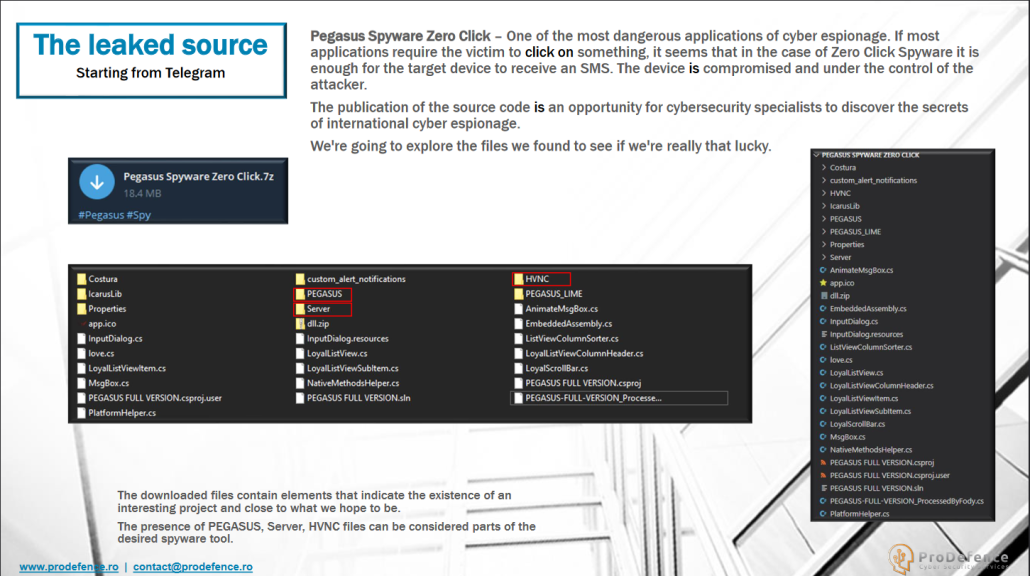
Pegasus Spyware Zero Click – One of the most dangerous applications of cyber espionage. If most applications require the victim to click on something, it seems that in the case of Zero Click Spyware it is enough for the target device to receive an SMS. The device is compromised and under the control of the attacker.

The publication of the source code is an opportunity for cybersecurity specialists to discover the secrets of international cyber espionage. We’re going to explore the files we found to see if we’re really that lucky.

Skip to content